Uptake
uptake fleet

Uptake Fleet: AI Predictive Maintenance for Fleets — Complete 2026 Guide
Uptake Fleet is an AI-powered predictive maintenance platform for commercial fleets. It plugs into your existing telematics and vehicle data — no new hardware needed — and uses machine learning to predict which vehicles and components are about to fail, before they cause a roadside breakdown. Now part of Bosch following the March 2026 acquisition.
What is Uptake predictive maintenance?
Uptake is a Chicago-based industrial AI company founded in 2014. Its core product Uptake Fleet is a predictive maintenance platform designed for commercial vehicle fleets in trucking, construction, federal government, and heavy equipment operations.
In March 2026, Bosch announced the acquisition of Uptake, combining Uptake's AI-driven analytics with Bosch's global expertise in mobility, diagnostics, and telematics. For buyers, this means the platform is backed by one of the world's most established names in automotive technology.
What does "predictive maintenance" actually mean?
It means using data to spot a problem before it becomes a breakdown. Traditional fleet maintenance works in two ways you either wait for a vehicle to break down (reactive) or you service it on a fixed schedule (preventive). Both waste money.
Uptake takes a third approach. It watches your vehicles' data continuously and flags specific components that are showing early signs of failure often days or weeks before anything visible goes wrong.
Uptake software — overview and key features
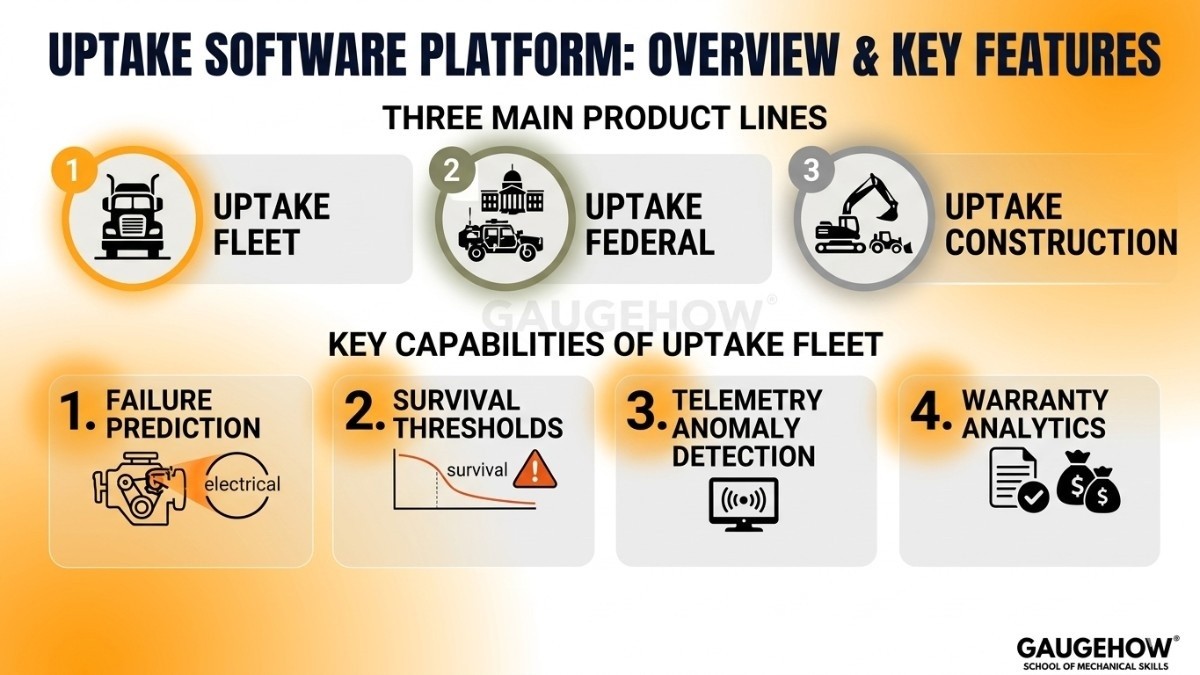
The Uptake software platform has three main product lines. Each targets a specific type of operation, but they all share the same AI analytics engine underneath.
The three Uptake products
1 Uptake Fleet — for commercial trucking, transportation, and mixed-asset fleets. Focuses on reducing roadside breakdowns and maintenance costs per vehicle.
2 Uptake Federal — a version built specifically for government and defence fleets. Designed around asset readiness requirements, compliance, and public-sector procurement standards.
3 Uptake for Construction — monitors heavy equipment like excavators, loaders, and haul trucks. Connects to equipment telematics systems already in place on most modern job sites.
Key capabilities of Uptake Fleet
Component-level failure prediction
Uptake doesn't just flag "engine fault." It identifies the specific component likely to fail — brake system, transmission, cooling, electrical — giving maintenance teams a precise repair target rather than a vague warning.Survival curve thresholds
For each component, Uptake sets statistical survival curves based on failure history. When a component's health score crosses a threshold, a maintenance alert fires. Users can customise these thresholds for their own fleet's risk tolerance.Anomaly detection on live telemetry
The AI continuously monitors incoming vehicle data and flags unusual patterns — temperature spikes, pressure drops, abnormal current draw — that don't match that vehicle's normal operating signature.Warranty analytics
Uptake automatically identifies vehicles and components eligible for warranty recovery — turning a process most fleets manage manually (or miss entirely) into an automated revenue and cost-saving tool.Inventory optimisation
By knowing which parts are likely to fail across the fleet in the coming weeks, Uptake helps parts managers stock the right inventory at the right time — reducing both emergency orders and over-stocking.Work Order Analytics
Beyond standard work order management, Uptake analyses historical work order data to surface patterns — which mechanics are most efficient, which repair types recur most often, and where maintenance process improvements are needed.Customisable dashboards and alerts
Fleet managers can filter alerts by time, severity, vehicle location, or affected system. The platform surfaces the highest-priority risks first so teams are not drowning in low-level notifications.
Uptake fleet analytics
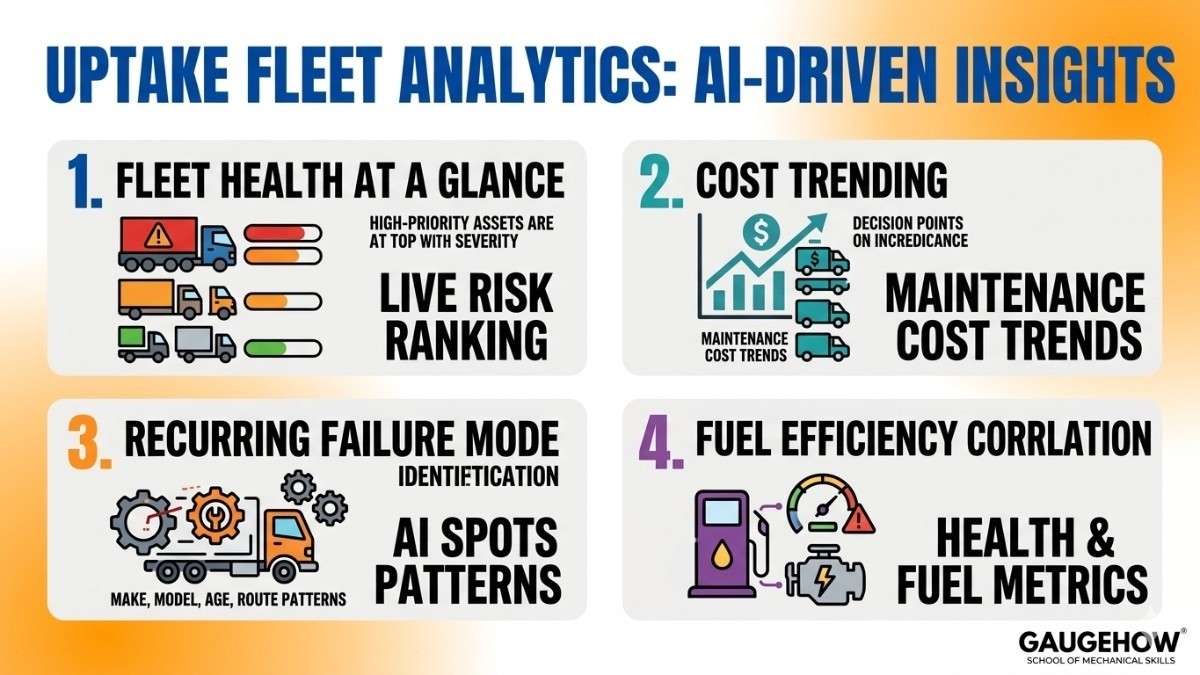
The analytics layer is where Uptake Fleet earns its differentiation. It goes beyond simple dashboard reporting and uses AI to surface patterns that human analysts would take weeks to find — or miss entirely.
Similar to Augury, Uptake uses AI-driven analytics to identify patterns that maintenance teams might otherwise miss. The difference is that Augury focuses heavily on factory equipment and industrial machinery, while Uptake specialises in commercial fleets and heavy mobile assets.
What the analytics actually show you
Fleet health at a glance — a live view of every asset's condition, ranked by risk severity. High-priority vehicles sit at the top.
Cost per vehicle trending — tracks maintenance spend per unit over time, making it easy to spot vehicles that are approaching replacement territory versus those worth continued investment.
Failure pattern identification — across large fleets, the AI spots recurring failure modes tied to vehicle make, model, age, or route — enabling fleet-wide corrective action, not just one-off repairs.
Fuel efficiency correlation — links vehicle health data to fuel consumption. A degraded fuel injector or air filter shows up in both the health score and the fuel efficiency metrics simultaneously.
Uptake fleet predictive maintenance for trucking
The trucking and transportation sector is Uptake Fleet's core market. For long-haul carriers, regional distribution fleets, and last-mile operators, a single unexpected breakdown can cascade into missed delivery windows, driver delays, and emergency roadside service costs that run into thousands of dollars per incident.
How trucking fleets use Uptake differently from other industries
Unlike a factory where a broken machine sits in one place, a broken truck can be stranded 500 miles from your nearest service facility. This makes prediction — not just detection — the critical capability.
Uptake Fleet predicts failures by analysing OBD (on-board diagnostics) data, J1939 diagnostic codes, and telematics feeds from providers already installed on most modern commercial trucks. No new hardware is required.
The platform processes this data continuously, applying survival curve models to flag components that are trending toward failure before a diagnostic code is ever thrown.
Common failure types Uptake catches in trucking fleets
Engine cooling system degradation — caught before overheating causes engine damage.
Brake system wear — predicted at the axle level, reducing both safety risk and emergency repair costs.
Transmission fault precursors — electrical and pressure anomalies that precede transmission failure by days or weeks.
Fuel system inefficiency — degraded injectors or filters showing up in fuel consumption data before a fault code is triggered.
Uptake pricing
Uptake does not publish a public price list on its website. Pricing is quote-based and varies by fleet size, the number of telematics integrations, and which modules you add. However, based on independent industry benchmarks and verified fleet management sources, here is what buyers should budget for:
Base Platform
$45–$70
per vehicle / month (estimated)
Fleet health monitoring
Anomaly detection + alerts
Standard telematics integrations
Work order analytics
Full Suite
$70–$100
per vehicle / month (estimated)
Component-level failure prediction
Survival curve thresholds
Warranty analytics module
Inventory optimisation
Custom dashboard + alert rules
Implementation
$5K–$50K
one-time (fleet size dependent)
Telematics setup and configuration
Data pipeline integration
Onboarding and training
Custom alert threshold tuning
Pros and cons
No platform is perfect. This is a balanced view — including the weaknesses that Uptake's own marketing will not highlight.
What works well
Component-level failure prediction — specific, actionable
Works with existing telematics — no new hardware needed
Warranty analytics recovers hidden revenue automatically
Inventory optimisation reduces emergency parts orders
Customisable survival curve thresholds per fleet profile
Backed by Bosch's global diagnostics expertise (post-2026)
Dedicated federal/government product — rare in this category
Where it falls short
No publicly listed pricing — requires a sales conversation
No self-serve free trial
Implementation cost ($5K–$50K) is a barrier for small fleets
Reporting depth limited for very large, complex fleets (per user reviews)
Mobile app experience less polished than Samsara
Bosch integration roadmap still evolving post-acquisition
Not suited for non-vehicle assets (manufacturing plant equipment)
Best for
Fleet size
Mid to large fleets — 50+ vehicles where per-unit insights deliver measurable ROI
Industries
Long-haul trucking, regional distribution, construction, federal / government operations
Team type
Fleet managers and maintenance directors who need data-driven prioritisation, not just GPS tracking
Data situation
Fleets already running Geotab, Samsara, or other telematics — Uptake layers on top
Key use case
Eliminating roadside breakdowns, recovering warranty claims, and reducing emergency repair spend
Not ideal for
Small fleets under 20 vehicles, manufacturing plant assets, or teams needing a free entry point
Integrations
Uptake Fleet is designed to work on top of telematics and fleet management systems you already have. Here is what it connects to out of the box.
Telematics providers
GeotabSamsaraMotive (KeepTruckin)Verizon ConnectZonarPeopleNet
Fleet management and CMMS systems
FleetioRTA Fleet360AssetWorksDossier FleetSAP (enterprise)REST API (custom)
Vehicle data protocols
J1939 CAN busOBD-II / OBD diagnosticsOEM telematics feedsAEMP ISO 15143-3 (construction)
The Geotab integration is worth highlighting specifically. Uptake and Geotab have a confirmed partnership, and for fleets already running Geotab hardware, the data pipeline is pre-configured — dramatically reducing implementation time and cost.
Deployment
Model
Cloud-native SaaS. All AI processing runs in Uptake's cloud. No on-premises software installation required on your fleet management side.
Data ingestion
Pulls from existing telematics feeds via API connections. No new hardware or sensors need to be installed on vehicles. Works with what you already have.
Setup time
Implementation typically takes 2–8 weeks depending on fleet size, the number of telematics integrations, and whether custom alert thresholds need to be built. Smaller fleets with Geotab can deploy faster.
Brownfield ready
Yes. Uptake is designed specifically for fleets with existing telematics infrastructure. It is an analytics layer on top — not a rip-and-replace of your current telematics provider.
Free trial
No self-serve trial. Proof-of-concept pilots available through Uptake's sales team for qualified fleets. Request through uptake.com.
Time to first alert
Typically 1–2 weeks after data pipelines are connected. The AI requires a short period of historical data to establish normal baselines for each vehicle.
Uptake vs Samsara
Samsara and Uptake are both widely used by commercial fleets — but they solve different problems. Understanding the distinction stops you from comparing the wrong things.
Samsara is a full telematics platform. It provides GPS tracking, ELD compliance, dashcam video, driver safety scoring, and real-time vehicle data. It is the system that collects and transmits fleet data.
Uptake Fleet is an analytics layer that sits on top of telematics data. It is not a GPS or ELD provider. Many fleets actually run both — using Samsara as their telematics provider and Uptake as their predictive intelligence layer.
Feature | Uptake Fleet | Samsara |
|---|---|---|
Primary purpose | Predictive failure analytics | Full telematics platform |
GPS / ELD tracking | No — analytics layer only | Yes — core feature |
Driver safety scoring | No | Yes — AI dashcam |
Component-level failure prediction | Yes — specific part-level alerts | Basic engine fault alerts only |
Warranty analytics | Yes — automated recovery | No |
Inventory optimisation | Yes | No |
Works with existing telematics | Yes — telematics agnostic | Requires Samsara hardware |
Pricing entry point | ~$45–$100/vehicle/mo | ~$27+/vehicle/mo |
Contract flexibility | Flexible | Typically 3-year contract |
Best for | Maintenance-focused fleet ops | Safety + compliance + telematics |
Can you use both together?
Yes — and many fleets do. Samsara collects and streams the vehicle data. Uptake analyses that data stream to add predictive intelligence. They are complementary tools, not direct substitutes.
Alternatives to Uptake Fleet
Uptake Fleet is a strong fit for mid-to-large commercial vehicle fleets focused on reducing breakdowns and maintenance costs.
If it doesn't match your situation, alternatives such as Siemens Senseye, Augury, Fleetio, and Samsara may be worth evaluating depending on whether you manage industrial assets, factory equipment, or commercial vehicle fleets.
Fleetio
Best pure fleet CMMS for maintenance management without the AI complexity. Excellent mobile UX, wide telematics integrations (Samsara, Geotab, Motive), and a 100,000+ service shop outsourced maintenance network. More accessible pricing for smaller fleets.
Mid-market
Geotab + Analytics
If you already use Geotab hardware, their native predictive maintenance module (MyGeotab) provides basic failure alerts without additional cost. Less sophisticated than Uptake's component-level AI, but a zero-cost option for Geotab customers.
Built-in option
Samsara
Best if you need a full-stack telematics platform — GPS, ELD, driver safety, and basic vehicle health — in a single contract. Not a replacement for Uptake's predictive depth, but a simpler all-in-one option for smaller or compliance-focused fleets.
Full telematics
Motive (KeepTruckin)
Strong telematics + ELD platform with growing AI maintenance features. Competitive pricing and a wide footprint in the US trucking market. Better mobile experience than Uptake. Less advanced on predictive analytics than Uptake or Geotab.
Trucking-focused
FAQ
What is Uptake predictive maintenance?
Uptake predictive maintenance is an AI software platform that analyses your fleet's existing vehicle data — from telematics, OBD diagnostics, and J1939 CAN bus — to predict which vehicles and components are about to fail before they do. It turns raw telematics data into specific, actionable maintenance alerts, ranked by severity and component type.
How does Uptake Fleet work?
Uptake Fleet connects via API to your existing telematics provider (Geotab, Samsara, Motive, etc.) and pulls vehicle diagnostic data continuously. Its AI engine builds a health baseline for each vehicle and component, then monitors for deviations. When a component's health score crosses a statistically-defined failure threshold, an alert is generated and surfaced in the Uptake dashboard — along with the specific component at risk and the recommended action.
How much does Uptake cost per vehicle?
Based on independent industry benchmarks, Uptake Fleet pricing falls between $45 and $100 per vehicle per month, depending on fleet size and which modules you subscribe to. Implementation costs add $5,000–$50,000 as a one-time fee. Uptake does not publish pricing publicly and requires a sales conversation for an exact quote. There is no self-serve free trial, but proof-of-concept pilots are available.
Does Uptake require new hardware or sensors?
No. Uptake Fleet is software-only and works with telematics hardware already installed on your vehicles. It connects via API to existing providers like Geotab, Samsara, or Motive. The only requirement is that your fleet is already generating telemetry data — which most modern commercial fleets are.
Is Uptake vs Samsara the same thing?
They are not the same category of tool. Samsara is a telematics platform that provides GPS tracking, ELD compliance, dashcam video, and basic vehicle fault alerts. Uptake Fleet is an analytics layer that sits on top of telematics data and provides component-level failure prediction and warranty recovery. Many fleets use both simultaneously — Samsara for compliance and tracking, Uptake for predictive maintenance intelligence.
Is Uptake now owned by Bosch?
Yes. Bosch announced the planned acquisition of Uptake in March 2026, combining Uptake's AI-driven predictive maintenance capabilities with Bosch's global expertise in automotive diagnostics, mobility, and telematics. The platform continues to operate under the Uptake name as of June 2026, with the Bosch integration roadmap still being developed.
Uptake uses AI to monitor fleet data, predict equipment failures early,and help trucking and industrial fleets improve maintenance and performance.