Tractian
tractian sensors
Tractian Sensors: How They Work, What They Cost, and Whether You Need Them
If your factory machines break down without warning, you're not alone — and Tractian sensors were built to fix exactly that. This guide breaks everything down in plain language, whether you're a student, a new maintenance technician, or just curious about what all the fuss is about.
What is Tractian?
Tractian is an industrial AI company founded in 2019 in São Paulo, Brazil. It makes hardware sensors and AI-powered software that help factories predict and prevent machine failures — before those failures cause costly, unplanned shutdowns.
Think of it as a fitness tracker for your factory floor. Just as a smartwatch monitors your heart rate and warns you about health risks, Tractian sensors monitor your machines and warn you when something is going wrong — often weeks in advance.
The company has raised $196M in funding from investors including Y Combinator and General Catalyst, and is trusted by manufacturers like Bosch, Whirlpool, Kraft Heinz, Cummins, and Stellantis.
Tractian sensors — how they actually work
Tractian sensors are the hardware heart of the system. They are small, wireless devices that physically attach to your equipment — no wiring, no drilling, no production shutdown required.
Installation is genuinely fast
Each sensor mounts magnetically or with an adhesive in under 3 minutes. One person can instrument an entire pump, motor, or compressor line in a single afternoon. That is a meaningful advantage over competitors who require professional installation teams.
What they measure
1 Vibration — detects subtle mechanical changes like bearing wear, misalignment, or imbalance that are invisible to the human eye or ear at early stages.
2 Temperature — unusual heat spikes often signal friction, lubrication problems, or electrical faults before they become critical.
3 RPM (rotation speed) — monitors whether a machine is running at the right speed or experiencing load-related anomalies.
4 Ultrasound — the Smart Trac Ultra model adds ultrasonic sensing, catching the earliest-stage bearing fatigue months before other sensors would flag it.
Tractian Smart Trac — key features
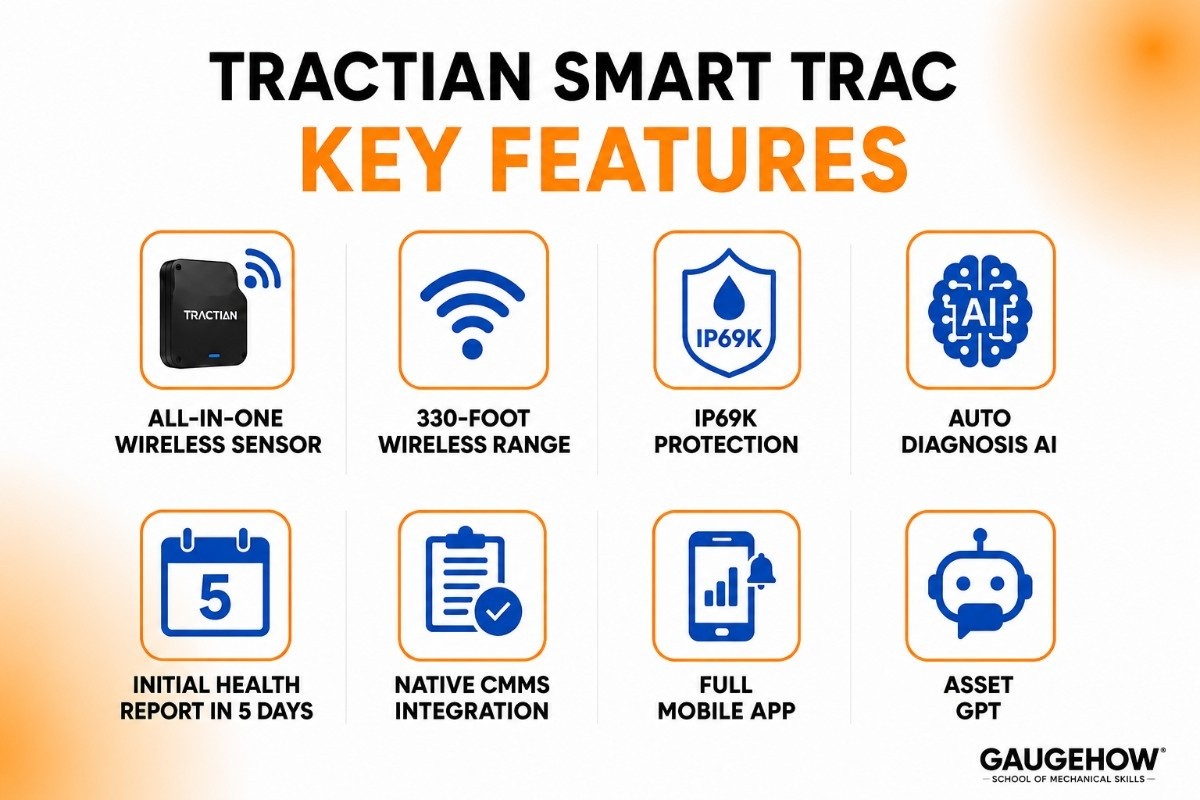
The Smart Trac Ultra is Tractian's flagship sensor. It is an all-in-one wireless device that combines vibration and ultrasonic sensing — something that used to require two separate pieces of hardware.
330-foot wireless range indoors — uses a 915 MHz proprietary protocol, which is far greater than Augury's 50-foot range. Means fewer gateways needed per plant.
IP69K protection rating — fully dust-proof and resistant to high-pressure water jets. Works in food processing, chemical plants, and outdoor environments.
Auto Diagnosis AI — Tractian's patented algorithm, trained on 3.5 billion+ data samples, automatically classifies fault type, severity, and recommended fix — no vibration analyst needed.
Initial health report in 5 days — within five days of installation, you get a full baseline report on all monitored assets. No waiting weeks for the system to "learn."
Native CMMS integration — detected faults automatically create work orders in Tractian's built-in CMMS (TracOS), including the fault description and suggested repair steps. No manual data entry.
Full mobile app — unlike some competitors whose mobile apps are limited to installation only, Tractian's app gives real-time monitoring, alerts, analytics, and offline access for technicians in the field.
Asset GPT — an AI assistant that auto-fills asset specs from a library of 6 million+ motors and 70,000 bearing models, so setup is nearly automatic even for less-technical teams.
How does Tractian work?
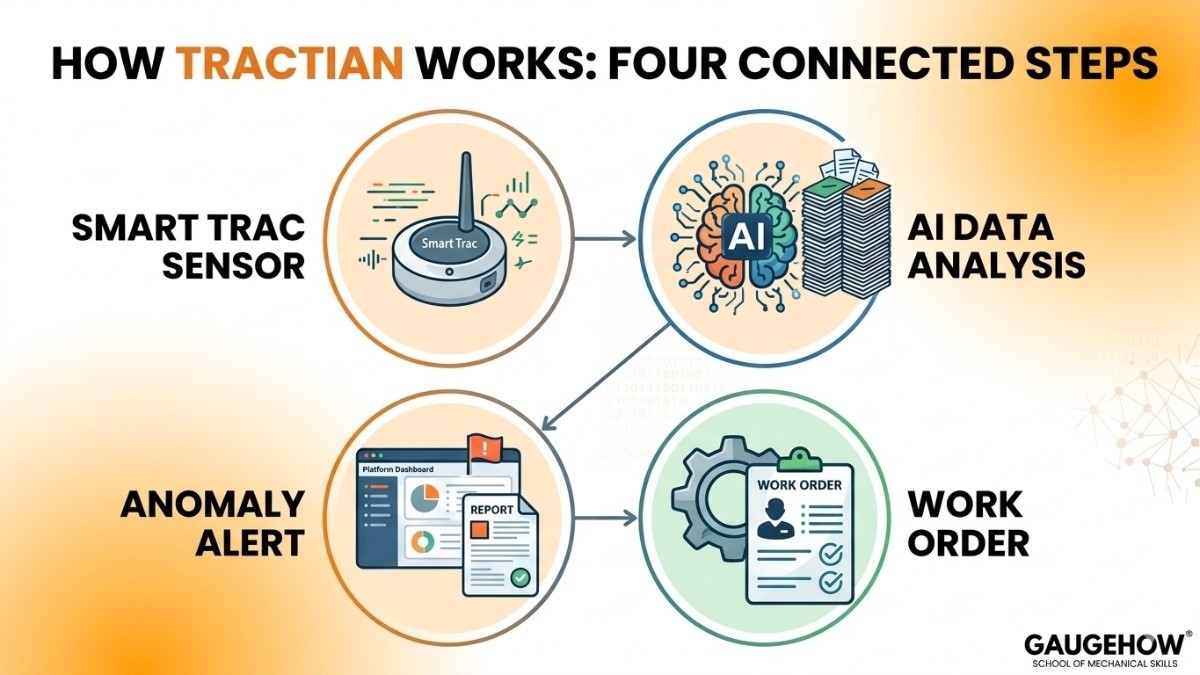
The whole system runs in four connected steps. Understanding these helps you see why it is different from older maintenance approaches.
1 Sensors collect data
Smart Trac devices attach to machines and stream vibration, temperature, and RPM data continuously to the cloud.
2 AI analyses patterns
Auto Diagnosis compares readings against 3.5 billion historical samples to spot early-stage faults — bearing wear, cavitation, misalignment.
3 Alert is generated
When an anomaly is confirmed, the platform creates a detailed diagnostic report with fault type, severity rating, and step-by-step repair instructions.
4 Work order is created
The CMMS automatically generates a work order, assigns it to the right technician, and tracks the fix from start to finish.
The key difference from traditional maintenance is that you go from "the machine broke" to "we knew three weeks ago and already scheduled the fix." That shift eliminates unplanned downtime — the most expensive thing that can happen in a factory.
Tractian prdictieve maintenance
Most factories run one of three maintenance strategies. Tractian belongs to the third — and most advanced — category:
Strategy | How it works | The problem |
|---|---|---|
Reactive | Fix it when it breaks | Expensive, chaotic, unsafe |
Preventive | Scheduled service every X weeks | Wastes money on healthy machines; still misses random failures |
Predictive (Tractian) | Service exactly when the data says you need it | Requires sensor investment up front — but pays back fast |
Tractian's predictive maintenance platform is built around the idea that every machine tells you it's about to fail — through changes in vibration frequency, rising heat, or speed irregularities — long before it actually stops.This approach is similar to platforms like Uptake, which use AI and machine data to identify failure risks before they become operational problems.
The difference is that Uptake is widely used in commercial fleets and heavy mobile assets, while Tractian focuses on industrial equipment inside manufacturing facilities. The sensors capture those whispers. The AI translates them into plain-language recommendations.
Real-world results back this up: customers report up to a 43% reduction in unplanned downtime and a 7x ROI in the first year of deployment.
Tractian pricing
Tractian does not publish a public price list — like most industrial AI platforms, it quotes based on the number of assets, sites, and modules you need. However, based on G2 reviews and verified industry sources, here is what buyers should expect.
CMMS Standard
~$60
per user / month (min. 5 users, billed annually)
Work order management
Asset tracking
PM scheduling
Mobile app access
Smart Trac + CMMS Bundle
Custom
quote-based; sensor hardware + software subscription
Smart Trac Ultra sensors included
Auto Diagnosis AI
Full CMMS + energy monitoring
Implementation support
Enterprise / Multi-site
Custom
volume pricing for 3+ plants
All bundle features
SAP / ERP integrations
Dedicated success team
ISO 27001 + SOC 2 compliance.
Pros and cons
No platform is perfect. Here is an honest breakdown based on G2, Capterra, and independent reviews — including the things Tractian would rather you not focus on.
What works well
3-minute plug-and-play sensor installation
330-ft wireless range — far fewer gateways needed
Auto Diagnosis gives specific fault names, not just alerts
Built-in CMMS removes need for a separate tool
Offline mobile access for plant-floor technicians
Initial health report in just 5 days of deployment
Asset GPT auto-fills machine specs — no manual entry
Where it falls short
Mobile app interface can feel complex on phones
Dashboard customisation is limited on lower tiers
Slower implementation for complex production cycles
No self-serve free trial — must request a demo
Hardware is proprietary — no third-party sensor support
Far fewer app reviews than MaintainX (26 vs 2,300 on App Store)
Best for
Plant size
Mid to large facilities with 10+ critical rotating assets
Industries
Automotive, food & beverage, chemicals, consumer goods, paper
Team type
Maintenance teams wanting AI diagnostics without needing a vibration analyst on staff
Use case
Preventing unplanned downtime on motors, pumps, fans, compressors, and gearboxes
Not ideal for
Non-rotating assets, very small shops, or teams needing a free/low-cost entry point
Integrations
Tractian is designed to fit into your existing tech stack, not replace it from scratch. Here is what it connects to out of the box.
ERP / CMMS integrations
SAP PM / S4HANAIBM MaximoOracle EAMInfor EAMUpKeepMaintainXLimble CMMSFiix
Sensor and industrial protocols
OPC-UAREST APIMQTTModbusPLC / SCADA data feeds
The SAP integration is worth highlighting separately. When Tractian's Auto Diagnosis confirms a fault, it can push a pre-filled work order directly into SAP PM — including the fault description, recommended procedure, and parts list. Maintenance planners see it instantly in SAP without needing to log in to a second system.
Deployment
Deployment model
Cloud-native SaaS. Data from sensors is transmitted to Tractian's cloud for AI processing and storage. No on-prem version available.
Sensor connectivity
915 MHz proprietary wireless protocol. Gateway communicates with sensors up to 330 ft indoors. No cellular required at sensor level.
Installation time
Under 3 minutes per sensor using magnetic or adhesive mounting. Self-install — no specialist required. Most mid-size plants are fully instrumented in 1–2 days.
Brownfield readiness
Fully designed for existing facilities. No production shutdown needed. Sensors go on top of existing machines — nothing is modified or rewired.
Offline capability
The mobile app works offline for field technicians. Work orders, asset histories, and diagnostic reports are accessible without internet, with auto-sync when back online.
Time to first value
Initial health report within 5 days of sensor installation. First anomalies typically flagged within 2–4 weeks.
Tractian vs Augury
This is the comparison people search most. Both are AI-powered predictive maintenance platforms that use vibration sensors. But they are quite different in practice.
Feature | Tractian | Augury |
|---|---|---|
Founded | 2019, São Paulo | 2011, New York |
Wireless range | 330 ft indoors | ~50 ft (2.4 GHz) |
Mobile app | Full monitoring + offline | Installation only |
Built-in CMMS | Yes — TracOS | No (requires integration) |
Sensor installation | Self-install, 3 min | Professional install team |
Human expert review | AI-led diagnostics | AI + certified engineers |
Ultra-low RPM | Limited | Yes (down to 1 RPM) |
Data library | 3.5B+ samples | Largest in industry |
Pricing entry point | More accessible | Enterprise ($50K+/year) |
Which one should you pick?
Choose Tractian if you want fast self-install, a built-in CMMS, strong mobile access, and a longer wireless range — especially for mid-market manufacturers who don't have a vibration analyst on staff.
Choose Augury if you are a large enterprise with ultra-low RPM assets, a dedicated reliability engineering team, and a budget for professional installation and human-validated diagnostics.
Tractian alternatives - tools worth considering
Tractian is not the right fit for everyone. Manufacturers evaluating predictive maintenance software also frequently compare solutions such as Factory AI, Augury, MaintainX, Limble CMMS, and IBM Maximo depending on their maintenance strategy, deployment requirements, and budget.
Best for large enterprises needing expert-validated AI diagnostics and ultra-low RPM coverage. Requires professional installation and has higher entry-level pricing. Strongest machine data library in the industry.
Enterprise
MaintainX
Best pure-play CMMS for teams that do not need built-in sensors. Excellent mobile experience (2,300+ App Store ratings vs Tractian's 26). Ideal for small-to-medium operations focused on work order management.
Mid-market
Limble CMMS
Strong CMMS with deep inventory tracking and compliance-ready features. No native sensors, but connects to third-party IoT hardware via API. Best for teams who already have sensors and need a management layer.
Mid-market
IBM Maximo
Enterprise-grade EAM platform with deep SAP/Oracle integration. Significantly more complex to implement than Tractian, but covers a wider asset scope including non-rotating equipment and facilities management.
Enterprise
FAQ — questions students and buyers ask most
What is Tractian, in simple terms?
Tractian is a company that makes small wireless sensors and AI software for factories. The sensors attach to machines like motors and pumps, monitor how they are running, and use artificial intelligence to warn the maintenance team weeks before a machine is about to fail.
It replaces the old approach of waiting for something to break before fixing it.
How does Tractian work step by step?
A Smart Trac sensor is mounted on a machine in under 3 minutes. It starts collecting vibration, temperature, and RPM data 24/7 and sends it wirelessly to Tractian's cloud.
The AI platform compares this data against 3.5 billion historical samples from similar machines and flags anomalies. When a fault is confirmed, it automatically creates a maintenance work order with the fault type and repair instructions.
How much does Tractian cost?
Tractian's CMMS software starts at approximately $60 per user per month, billed annually, with a minimum of 5 users. The full hardware-and-software bundle (Smart Trac sensors + CMMS) is quote-based and varies by the number of assets and sites.
There is no self-serve free trial, but Tractian offers guided demos and pilot programmes for qualified manufacturers.
Is Tractian cloud-based?
Yes. Tractian is a fully cloud-hosted SaaS platform. Sensor data is transmitted wirelessly to Tractian's cloud servers for AI processing. There is no on-premises deployment option.
The mobile app does support offline use — technicians can access work orders and asset data without internet, and the app syncs automatically when back online.
Does Tractian replace a CMMS?
Yes — Tractian includes its own built-in CMMS called TracOS, which handles work orders, preventive maintenance scheduling, asset tracking, and inventory.
This is a key differentiator from Augury, which is sensors-and-diagnostics only and requires a separate CMMS. If you already use SAP, IBM Maximo, or another CMMS, Tractian can integrate with it rather than replace it.
What companies use Tractian sensors?
Tractian is trusted by over 1,500 manufacturers globally. Notable customers include Bosch, Kraft Heinz, Whirlpool, Cummins, Hyundai, Johnson Controls, Carrier, P&G, and Stellantis.
The platform is especially popular in automotive, food and beverage, and consumer goods manufacturing.
Tractian uses sensors and AI to monitor machine vibration and temperature in real time, reduce downtime, and keep equipment running smoothly.