Mechanical Engineering Internship Interview Questions and Answers


Deepak S Choudhary
Learn More in This Video
Subscribe to GaugeHow for More
Internship interviews for mechanical engineering students sit somewhere between a campus placement interview and a casual conversation. Interviewers know you're still learning, so they're mostly checking for solid fundamentals, genuine curiosity, and whether you can communicate clearly under a bit of pressure.
Background and Motivation Questions
1. Tell me about yourself and your academic background.
Briefly mention your year of study, specialization if any, and one or two things that define your engineering interests so far. Keep it focused rather than repeating your entire resume.
End with a short line connecting your background to why you're interested in this internship. This gives the interviewer a clear, memorable starting point.
2. Why do you want to intern with our company specifically?
Mention something specific you learned about the company, like a product, project, or industry focus, rather than a generic answer. Connect that specific detail to your own interests or coursework.
This shows genuine research rather than a copy-paste application. A specific, personal reason always lands better than a vague one.
3. What do you hope to learn from this internship?
Share one or two realistic learning goals tied to your current skill level, like gaining hands-on CAD experience or understanding real manufacturing processes. Avoid overly broad answers like "learn everything about engineering.
" A focused, honest answer shows self-awareness about where you currently stand. It also signals you'll be an engaged, curious intern.
4. Why did you choose mechanical engineering as your field of study?
Give a genuine reason, whether it's curiosity about machines, a specific experience, or an early interest in how things work. Keep the answer personal rather than generic or rehearsed-sounding.
A short, authentic reason is far more memorable than a textbook-style answer. This is often one of the easiest questions to sound genuinely confident on.
5. What are you hoping to gain from a real workplace experience compared to classroom learning?
Mention the practical, hands-on exposure that classroom learning typically can't fully provide, like working with real equipment or seeing how teams collaborate. Be honest that you're still building experience, since interviewers expect this from an intern candidate.
This shows realistic expectations rather than overconfidence. It also demonstrates that you understand the internship's actual purpose.
Core Technical Fundamentals Questions
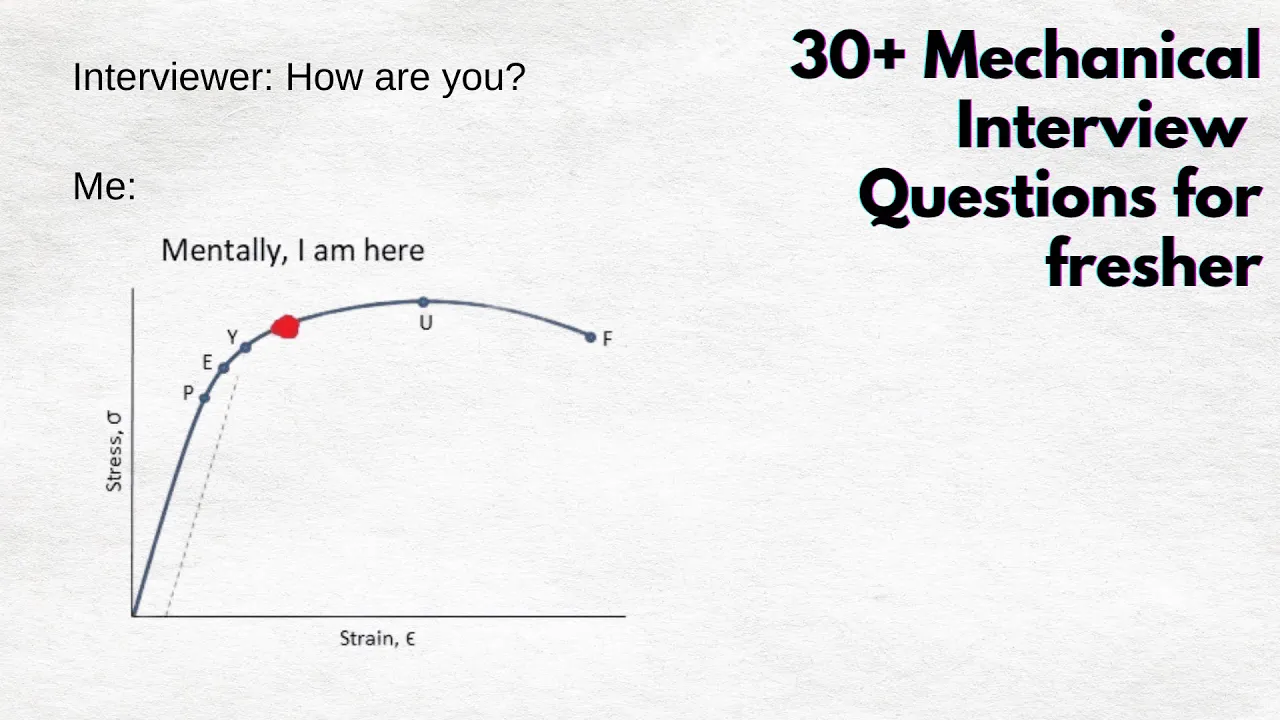
6. What is the difference between stress and strain?
Stress is the internal resisting force per unit area within a material under load. Strain is the resulting deformation relative to the material's original size.
This relationship is fundamental to understanding how materials behave under load. It's one of the most commonly asked basic questions in mechanical interviews.
7. What is the difference between heat and temperature?
Heat is energy transferred between objects due to a temperature difference between them. Temperature is a measure of the average kinetic energy of a substance's particles.
Confusing these two terms is a common early mistake interviewers watch for. Getting this distinction right shows solid grasp of thermodynamics basics.
8. What is the difference between kinetic and potential energy?
Kinetic energy is the energy an object has due to its motion. Potential energy is stored energy based on an object's position or configuration, like height above the ground.
Both convert into each other in many mechanical systems, like a swinging pendulum. This concept underlies much of basic mechanics and dynamics coursework.
9. What is the difference between laminar and turbulent flow?
Laminar flow moves in smooth, orderly layers with minimal mixing. Turbulent flow is chaotic and mixes rapidly, typically occurring at higher speeds or larger scales.
Reynolds number is used to predict which type of flow will occur. This concept comes up frequently in fluid mechanics coursework and interviews alike.
10. What is Young's Modulus, and what does it tell you about a material?
Young's Modulus measures a material's stiffness, defined as the ratio of stress to strain within its elastic range.
A higher value means the material resists deformation more under a given load. It helps engineers choose appropriate materials for a given application. It's a commonly tested basic material property question.
Coursework and Projects Questions
11. What has been your favorite subject in your mechanical engineering coursework so far, and why?
Choose a genuine favorite and briefly explain what specifically interests you about it. This gives the interviewer insight into your natural strengths and interests.
Avoid picking a subject just because it sounds impressive if it isn't genuinely your favorite. Authenticity here matters more than trying to guess the "right" answer.
12. Describe a class project you're proud of.
Briefly explain the project's goal, your specific contribution, and what you learned from it. Keep the explanation clear and simple, avoiding excessive technical jargon.
Interviewers want to see genuine involvement and understanding, not just participation. A concise, well-structured answer works better than a long, detailed one.
13. Have you worked on any personal or extracurricular engineering projects?
Mention any relevant project, even a small one, like a personal build, a competition team, or a hobby project. These often stand out more than coursework since they show genuine initiative.
If you don't have one yet, it's fine to say so honestly and mention what you're currently interested in exploring. Genuine enthusiasm can matter as much as the project itself at this stage.
14. What was the most challenging part of a project you've worked on?
Choose a real challenge and briefly explain how you worked through it, even if the solution wasn't perfect. This shows genuine problem-solving experience rather than a flawless, unrealistic story.
Interviewers understand that student projects come with real limitations and setbacks. Honest reflection here is more valuable than trying to sound impressive.
15. How do you approach a problem you don't immediately know how to solve?
Explain a simple, practical approach, like breaking the problem into smaller parts or researching similar solved problems first. Mention that you're comfortable asking a professor, mentor, or peer for guidance when needed.
This shows resourcefulness without pretending you can solve everything entirely alone. It's a common way interviewers gauge problem-solving maturity in students.
Tools and Software Questions
16. What CAD software are you familiar with?
Name the specific software you've used, like AutoCAD or SolidWorks, and briefly mention what you've used it for. If your experience is mostly academic, it's fine to say so honestly.
A course like SolidWorks or AutoCAD can help build confidence here if you're still developing this skill.
17. Have you used any simulation or analysis software, like FEA or CFD tools?
Mention any exposure you've had, even if it was limited to coursework or a single project. If you haven't used these tools yet, it's fine to express genuine interest in learning them during the internship. Honesty here is far better than overstating unfamiliar software experience. Interviewers generally expect limited exposure at the internship stage.
18. Do you have any programming or scripting experience relevant to engineering?
Mention any experience with tools like MATLAB, Python, or basic C or C++, even at a beginner level. If you're just starting out, mention your interest in developing this skill further.
A course like MATLAB is a practical way to build this if you haven't started yet. Basic scripting knowledge is increasingly valued even for entry-level roles.
19. Are you familiar with any manufacturing processes, like CNC machining or 3D printing?
Mention any hands-on or academic exposure you've had, even if it's limited to a lab session or short project. If you haven't had direct exposure, it's fine to express interest in learning more about it.
A course like CNC Programming can help build foundational understanding here. Genuine curiosity about manufacturing processes is a positive signal for internship roles.
20. How comfortable are you learning new software or tools quickly?
Share a specific example of when you picked up a new tool or skill relatively quickly, even outside of engineering. This shows adaptability, which matters a lot for interns who'll likely need to learn company-specific tools. Avoid claiming you're an expert at everything, since that can come across as overconfident. A genuine, example-backed answer works best here.
Workplace Readiness Questions
21. How do you handle working as part of a team?
Share a genuine example of a team project and your role within it. Mention that you value clear communication and are comfortable both leading and supporting depending on what the situation calls for.
Keep the example specific rather than speaking only in general terms. This shows real teamwork experience, even from an academic setting.
22. How do you prioritize tasks when you have multiple deadlines?
Explain a simple, practical approach, like ranking tasks by urgency and importance. Mention a specific example, like managing coursework alongside a project deadline.
A clear, honest answer here reflects well even without extensive professional experience. Interviewers understand that internship candidates are still developing this skill.
23. How do you handle receiving feedback or criticism on your work?
Explain that you view feedback as a genuine opportunity to improve rather than something to take personally. If you have a specific example of applying feedback constructively, briefly mention it.
This shows maturity and openness to learning, both highly valued in interns. Avoid sounding defensive or dismissive of past feedback you've received.
24. Are you comfortable asking questions when you're unsure about something?
Answer honestly that you are, since asking thoughtful questions is generally seen as a strength, not a weakness, especially for interns. Mention that you try to first attempt understanding something yourself before asking, to show initiative.
This balance of independence and appropriate question-asking is exactly what most supervisors want from an intern. Overstating complete independence can actually come across as a red flag here.
25. What does professionalism mean to you in a workplace setting?
Share genuine qualities like punctuality, clear communication, accountability, and respect for colleagues. Keep the answer practical and specific rather than overly abstract.
A brief personal example, if you have one, strengthens this answer further. This question checks basic workplace readiness beyond just technical skill.
Quick Behavioral and Closing Questions
26. Describe a time you worked under pressure or a tight deadline.
Briefly explain the situation, how you managed it, and the outcome. Focus on the specific steps you took rather than just describing the stress itself.
A calm, structured explanation reflects well here. Keep the example genuine, even if it's from an academic rather than a professional setting.
27. What is a mistake you've made, and what did you learn from it?
Choose a genuine, appropriately-scaled mistake and focus mainly on what you learned and changed afterward. Avoid overly minor examples that seem rehearsed or insignificant.
This question tests self-awareness more than the mistake itself. A thoughtful answer here often stands out more than a flawless track record would.
28. How do you stay updated on developments in mechanical engineering or your areas of interest?
Mention specific habits, like following industry news, technical blogs, or relevant online courses. If you're just starting to build this habit, it's fine to say so honestly while mentioning your intent to improve it.
This shows genuine curiosity beyond just coursework requirements. Interviewers value candidates who show interest in learning outside the classroom too.
29. Do you have any questions for us about the internship or the team?
Always have two or three thoughtful questions ready about the team's projects, what a typical day looks like, or growth opportunities during the internship.
Avoid asking only about compensation or perks at this stage. Genuine, specific questions show real interest in the role. This is also a good chance to clarify anything about expectations.
30. Why should we choose you for this internship over other candidates?
Summarize your genuine strengths, like curiosity, specific coursework or project experience, and willingness to learn quickly. Keep it confident but grounded in real examples rather than generic self-praise.
A short, specific answer here leaves a stronger final impression than a long, vague one. This is your chance to briefly reinforce your best points before the interview ends.
FAQ
Do internship interviews expect the same technical depth as full-time job interviews?
No, internship interviews generally focus more on fundamentals, attitude, and potential rather than deep specialized knowledge. Interviewers understand you're still a student and adjust their expectations accordingly.
Should I mention limited or no prior internship experience?
Yes, it's completely fine to be upfront about this, since internships are often a student's first real workplace experience. Focus instead on coursework, projects, and genuine enthusiasm to learn.
What's the most common mistake students make in internship interviews?
Overstating skills or experience they don't actually have, which often gets exposed through simple follow-up questions. Honest, confident answers about your actual current level are far more effective.
Is it okay to say I don't know the answer to a technical question?
Yes, especially for internship interviews, saying "I'm not sure, but here's how I'd approach finding out" is a strong, honest response. Interviewers generally respect this more than a guessed or incorrect answer.
How important is software or tool experience for landing an internship?
It helps, but genuine enthusiasm to learn matters just as much at this stage. Building some familiarity through a course like AutoCAD beforehand can still give you a meaningful edge.
Conclusion
Mechanical engineering internship interviews reward genuine curiosity, solid fundamentals, and honest self-awareness more than polished, rehearsed answers. Use these 30 questions to build real confidence in talking about your background, coursework, and readiness for a workplace environment.
If you're looking to build a stronger foundation before your internship search, GaugeHow's free course is a good starting point before exploring more specialized options like SolidWorks or MATLAB.