CMM Programmer Roadmap: A Step-by-Step Career Guide
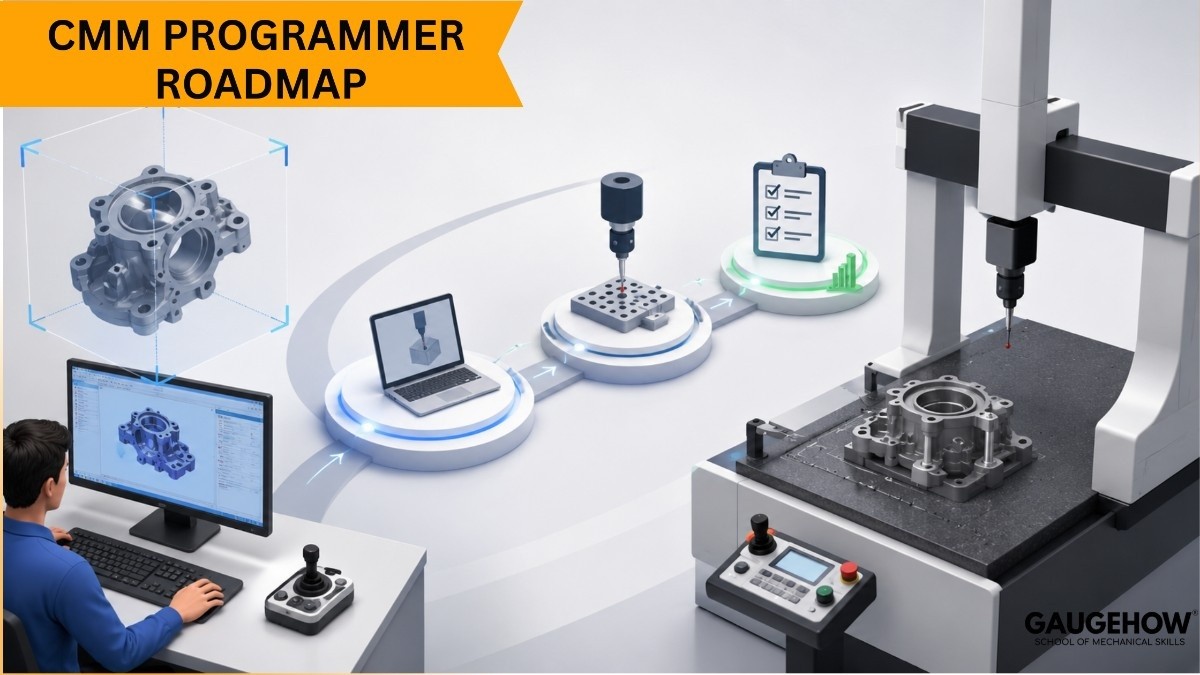
Want to become a CMM programmer but not sure whether to start with print reading, CAD, or the software itself? You are not alone.
Most beginners jump straight into learning a CMM software package without ever building the drawing interpretation and measurement fundamentals that make a program actually correct, not just technically running.
This roadmap breaks the career down into clear, ordered stages. No vague advice like "learn CMM programming." Just the drawing, CAD, and measurement skills that actually show up in real job postings, in the order you should learn them.
What Does a CMM Programmer Actually Do?
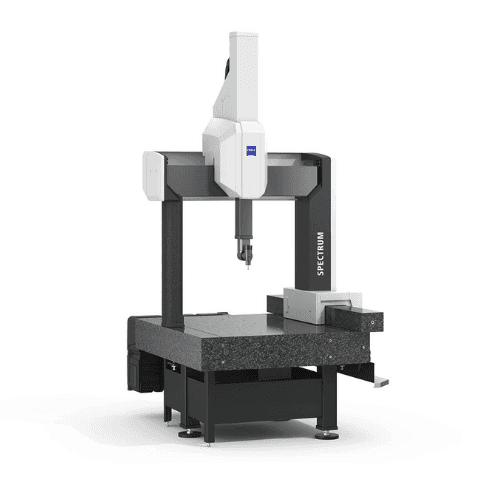
A CMM programmer writes and runs inspection routines on a coordinate measuring machine to verify that manufactured parts match their engineering drawing. In practice, this means:
Reading engineering drawings and identifying every dimension and GD&T callout that needs verification
Building or importing a reference CAD model the CMM program measures against
Writing a probing routine that touches the correct features in the correct order
Interpreting inspection results and flagging out-of-tolerance features
Troubleshooting probe collisions, fixture issues, and measurement anomalies
Documenting inspection reports that quality and production teams rely on
It's a role that sits at the intersection of print reading, CAD, and precision measurement. A CMM can only measure what you tell it to, so a programmer who misreads a tolerance produces a report that looks complete but is actually wrong.
CMM Programmer Roadmap: Step by Step
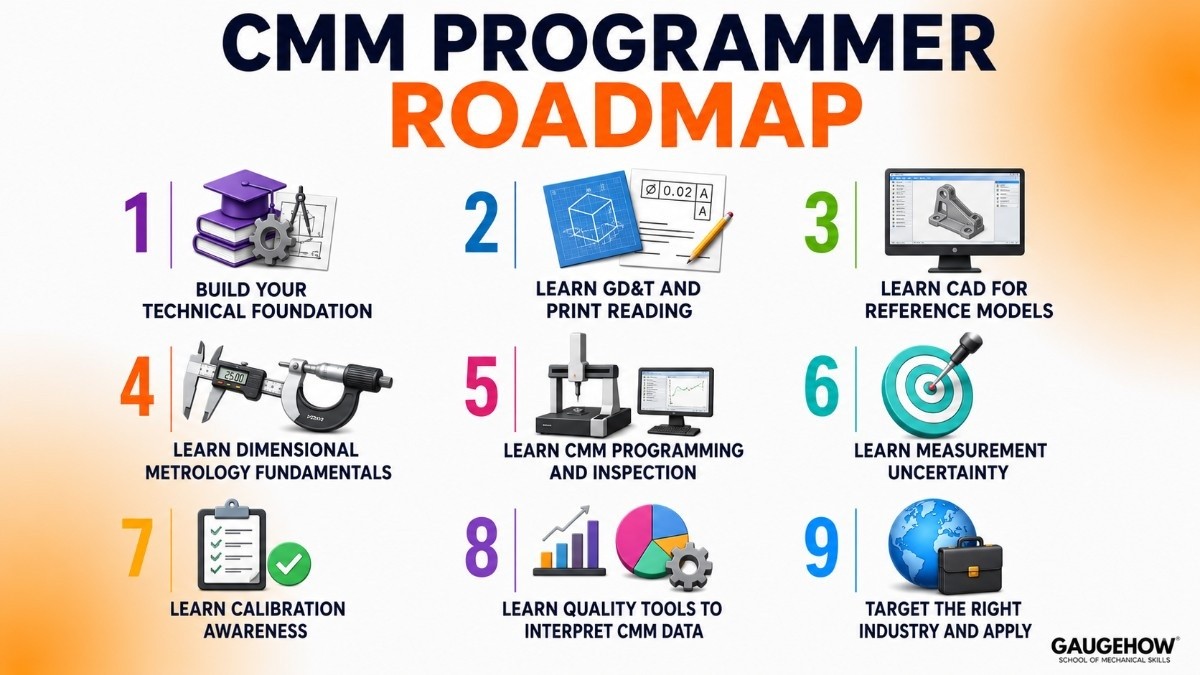
Step 1: Build Your Technical Foundation
Most CMM programming roles ask for a diploma or bachelor's degree in mechanical, manufacturing, or quality engineering, though many programmers move into the role from machining or inspection backgrounds.
If you are still studying, prioritize electives in manufacturing processes and basic statistics. If you already have the background, this step is done. Move on.
Step 2: Learn GD&T and Print Reading
This is the single most important skill in CMM programming, and it shows up on day one of the job. If you cannot read a feature control frame correctly, you will program the wrong measurement, and the CMM will happily report an incorrect result with total confidence.
The GD&T and Engineering Graphics course covers exactly the symbols and logic used on real production drawings.
Step 3: Learn CAD for Reference Models
Most CMM programs are built against a 3D reference model, not just a 2D drawing, so being able to read, and sometimes build or clean up, a CAD model is essential.
SolidWorks 2024 and Fusion 360 are both strong starting points, depending on which platform your target companies use.
Step 4: Learn Dimensional Metrology Fundamentals
Before touching CMM software specifically, you need to understand measurement itself: least count, the smallest increment an instrument can reliably resolve, and how measurement accuracy relates to the tolerance you are trying to verify.
The Engineering Metrology & 3D Measurement course covers this exact foundation, which every CMM program you write later depends on.
Step 5: Learn CMM Programming and Inspection
This is the core of the role. You need to understand how to build a probing routine, sequence measurements efficiently, and interpret results against the ISO 10360 standard most companies inspect against.
The CMM Inspection & ISO 10360 course covers exactly this skill set, from setup through full inspection routines.
Step 6: Learn Measurement Uncertainty
A CMM result is never perfectly exact, and understanding how much confidence to place in a measurement is what separates a programmer who just runs a routine from one who can defend a borderline result under scrutiny.
The Uncertainty Measurement course covers exactly this concept, including how probe accuracy and environmental factors affect your results.
Step 7: Learn Calibration Awareness
A CMM is only as trustworthy as its own calibration, and understanding the basics of calibration and traceability helps you recognize when a result might be off due to the machine itself rather than the part.
The Calibration Process (ISO/IEC 17025) course covers this exact foundation.
Step 8: Learn Quality Tools to Interpret CMM Data
Producing an inspection report is only half the job. Understanding how that data feeds into root cause analysis and process control makes you far more valuable to the teams relying on your reports.
The 7 QC Tools course and Basics of 6 Sigma course both build this analytical layer on top of your CMM skills.
Step 9: Target the Right Industry and Apply
CMM programming hiring looks different by sector. Aerospace and medical device manufacturing demand strict traceability and full inspection documentation.
Automotive wants fast, high-volume programs tied to statistical process control. The Aerospace industry page and Automotive industry page are good places to see what skills each sector emphasizes before you apply.
Before interviews, review common technical questions so a GD&T or probing strategy scenario does not catch you off guard. The Interview Q&A Hub has role-specific practice questions, and the Practice / MCQ Tests section is useful for a quick knowledge check before a technical round.
🔧 Trusted by 23,000+ Happy Learners
Industry-Ready Skills for Mechanical Engineers
Upskill with 40+ courses in Design/CAD, Simulation, FEA/CFD, Manufacturing, Robotics & Industry 4.0.
CMM Programmer Skills Checklist
Skill Area | Beginner | Job Ready |
|---|---|---|
GD&T and print reading | Recognizes basic symbols | Can identify exactly what tolerance a feature control frame requires |
CAD reference models | Can open and view a model | Can align a CAD model correctly for CMM programming |
Dimensional metrology | Knows what least count means | Can judge whether a measurement approach suits a tolerance |
CMM programming | Aware CMMs exist | Can build and run a full probing routine independently |
Measurement uncertainty | Knows a measurement has some error | Can explain the uncertainty behind a borderline result |
Quality tools | Knows the 7 QC tools by name | Can use inspection data to support a root cause investigation |
CMM Programmer vs Metrology Engineer vs Quality Engineer
These three roles overlap constantly, and smaller companies often blend them into one job.
Role | Main Focus | Typical Tools |
|---|---|---|
CMM Programmer | Writing and running coordinate measuring machine inspection routines | CMM software, GD&T, CAD reference models |
Metrology Engineer | Specializing broadly in measurement systems and uncertainty | Precision instruments, uncertainty budgets, CMM |
Quality Engineer | Ensuring parts and processes meet spec and standards overall | GD&T, CMM, 7 QC tools, root cause analysis |
A strong CMM programmer usually understands enough broader metrology and quality principles to work closely with those specialists without needing every detail explained.
If measurement work beyond CMM programming specifically interests you, it's worth comparing this against the metrology learning path before deciding how narrowly to specialize.
Frequently Asked Questions
Q: Do I need a specific degree to become a CMM programmer?
A: Not always. A diploma or degree in mechanical, manufacturing, or quality engineering helps, but many CMM programmers move into the role from machining, inspection, or quality technician backgrounds with the right hands-on training.
Q: Which CMM software should I learn first?
A: The core probing and GD&T concepts transfer across common software packages, so start with whichever platform is most widely used in your target industry or region and build the fundamentals there first.
Q: Is CAD knowledge really necessary for CMM programming?
A: Yes, in most modern roles. Programs are typically built against a 3D reference model, and being able to read or adjust that model correctly is essential for aligning the part and building an accurate probing routine.
Q: How long does it take to become job ready as a CMM programmer?
A: With a relevant technical background already in hand, most people reach job ready in six months to a year by learning GD&T, CAD basics, dimensional metrology, and completing one hands-on CMM inspection project they can walk through in an interview.
Q: Which industries hire the most CMM programmers?
A: Aerospace, automotive, medical device, and general precision manufacturing all hire heavily for this role, since each depends on verifying complex geometry against tight tolerances.
Conclusion
Becoming a CMM programmer is less about memorizing one software package and more about being able to read a drawing correctly, build an accurate reference model, and trust the measurement behind every result you report.
Follow the roadmap in order: technical foundation, GD&T, CAD for reference models, dimensional metrology fundamentals, CMM programming and inspection, measurement uncertainty, calibration awareness, then quality tools to interpret your data.
Ready to build the skill set? Start with the CMM Inspection & ISO 10360 course on GaugeHow to build the core programming skills this roadmap is built around.