Metrology Engineer Roadmap: A Step-by-Step Career Guide

Want to specialize in metrology but not sure whether to start with dimensional measurement, calibration, or statistics? You are not alone. Most engineers pick up measurement skills piecemeal on the job, without ever building them in an order that actually makes the specialization click.
This roadmap breaks the career down into clear, ordered stages. No vague advice like "learn measurement." Just the instruments, standards, and skills that actually show up in real metrology job postings, in the order you should learn them.
What Does a Metrology Engineer Actually Do?
A metrology engineer specializes in measurement itself: making sure every dimension, pressure, or physical property reported by a company can actually be trusted. In practice, this means:
Selecting the right measuring instrument for a given tolerance or application
Programming and running CMM inspections on complex geometry
Calibrating instruments and maintaining traceability to known standards
Calculating and reporting measurement uncertainty alongside results
Auditing measurement processes against standards like ISO 17025
Supporting quality and design teams with reliable measurement data
It's a role built entirely on precision and trust. Every other engineering decision in a company, from design tolerances to final inspection, ultimately depends on the accuracy of the measurements a metrology engineer is responsible for.
Metrology Engineer Roadmap: Step by Step
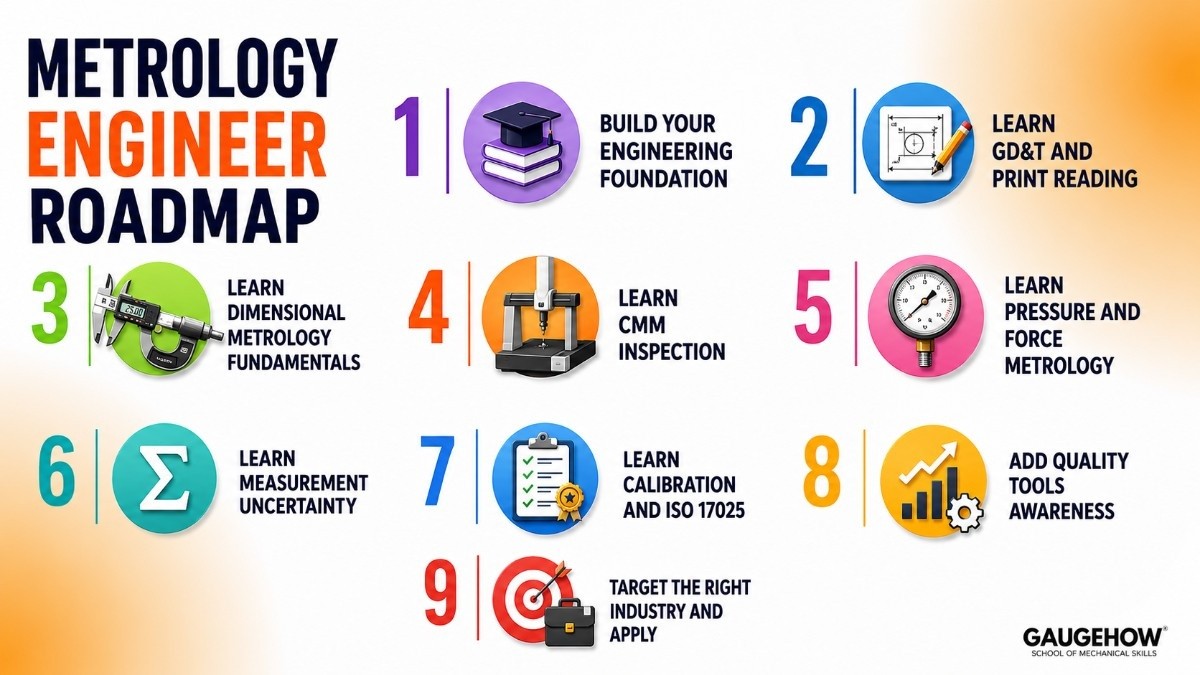
Step 1: Build Your Engineering Foundation
Most metrology roles ask for a bachelor's degree in mechanical, industrial, or instrumentation engineering. If you are still studying, prioritize electives in statistics, materials science, and instrumentation. If you already have the degree, this step is done. Move on.
Step 2: Learn GD&T and Print Reading
Before you can measure anything correctly, you need to know exactly what you are supposed to be checking. Misreading a tolerance callout means every measurement skill that follows gets applied to the wrong target.
The GD&T and Engineering Graphics course covers exactly the symbols and logic used on real production drawings.
Step 3: Learn Dimensional Metrology Fundamentals
This is the core of the role. You need to understand least count, the smallest increment an instrument can reliably resolve, and how to choose an instrument precise enough for a given tolerance.
A vernier caliper typically resolves to 0.02 millimeters, a micrometer to 0.01 millimeters, and picking the wrong one for a tight tolerance is a mistake that shows up constantly among beginners. The Engineering Metrology & 3D Measurement course covers this exact foundation.
Step 4: Learn CMM Inspection
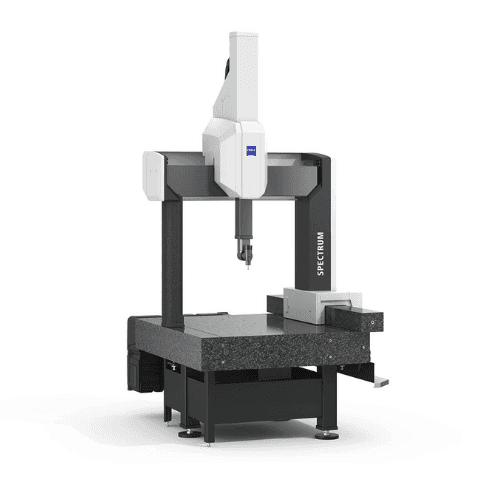
Coordinate measuring machines are the standard tool for verifying complex geometry that hand tools cannot check reliably. Programming and interpreting a CMM inspection routine is expected in most metrology roles above entry level.
The CMM Inspection & ISO 10360 course covers this exact skill, following the international standard most companies inspect against.
Step 5: Learn Pressure and Force Metrology
Beyond dimensional checks, many products and processes depend on pressure and force staying within a controlled range, from hydraulic systems to sealed enclosures.
This is a more specialized branch of metrology, but it shows up often enough in real industry work to be worth building early in your career. The Pressure Measurement course covers exactly this area.
Step 6: Learn Measurement Uncertainty
A single measurement is never perfectly exact, and understanding how much confidence to place in a result is what separates a genuine metrology specialist from someone who just reads a display and moves on.
This includes understanding how least count, calibration error, and environmental conditions combine into an overall uncertainty budget. The Uncertainty Measurement course covers exactly this concept.
Step 7: Learn Calibration and ISO 17025
Every instrument you use is only trustworthy if it is properly calibrated and traceable back to a known standard. Understanding calibration intervals and the ISO/IEC 17025 standard that governs testing and calibration labs is essential, and often the deciding factor in whether you are considered job-ready for a dedicated metrology role.
The Calibration Process (ISO/IEC 17025) course and ISO 17025:2017 & Internal Audit course both build this compliance-focused skill set.
Step 8: Add Quality Tools Awareness
While your specialization is measurement itself, understanding how that measurement data gets used downstream makes you far more valuable to the teams you support.
The 7 QC Tools course and Basics of 6 Sigma course both build this awareness, helping you see how your measurement work feeds into root cause analysis and process control.
Step 9: Target the Right Industry and Apply
Metrology hiring looks different by sector. Aerospace and medical device manufacturing demand strict traceability and documentation discipline.
Automotive wants fast, high-volume dimensional checks tied to statistical process control. The Aerospace industry page and Automotive industry page are good places to see what skills each sector emphasizes before you apply.
Before interviews, review common technical questions so a least count or calibration scenario does not catch you off guard. The Interview Q&A Hub has role-specific practice questions, and the Practice / MCQ Tests section is useful for a quick knowledge check before a technical round.
🔧 Trusted by 23,000+ Happy Learners
Industry-Ready Skills for Mechanical Engineers
Upskill with 40+ courses in Design/CAD, Simulation, FEA/CFD, Manufacturing, Robotics & Industry 4.0.
Metrology Engineer Skills Checklist
Skill Area | Beginner | Job Ready |
|---|---|---|
GD&T and print reading | Recognizes basic symbols | Can identify exactly what tolerance a callout requires |
Dimensional metrology and least count | Knows what least count means | Can select the right instrument for a given tolerance |
CMM inspection | Aware CMMs exist | Can program and interpret a CMM inspection routine |
Pressure and force metrology | Knows pressure measurement exists as a concept | Can select and apply the right pressure measurement method |
Measurement uncertainty | Knows a measurement has some error | Can calculate and report an uncertainty budget |
Calibration and ISO 17025 | Knows calibration is required | Can explain how a lab maintains ISO 17025 compliance |
Metrology Engineer vs Quality Engineer vs Calibration Technician
These three roles overlap constantly, and smaller companies often blend them into one job.
Role | Main Focus | Typical Tools |
|---|---|---|
Metrology Engineer | Specializing specifically in measurement systems and uncertainty | Precision instruments, uncertainty budgets, CMM |
Quality Engineer | Ensuring parts and processes meet spec and standards broadly | GD&T, CMM, 7 QC tools, root cause analysis |
Calibration Technician | Maintaining and calibrating measurement instruments themselves | Calibration standards, traceability records |
A strong metrology engineer usually understands enough broader quality principles to work closely with quality teams without needing every root cause explained to them. If the wider quality role interests you more than measurement specifically, it's worth comparing this against the Quality Engineer career track before committing to one path.
Frequently Asked Questions
Q: Do I need a specific degree to become a metrology engineer?
A: Most employers prefer a bachelor's degree in mechanical, industrial, or instrumentation engineering, though candidates from calibration technician or quality inspection backgrounds are also hired regularly with the right hands-on experience.
Q: What is the difference between a metrology engineer and a calibration technician?
A: A calibration technician focuses specifically on maintaining and calibrating instruments day to day. A metrology engineer takes a broader view, selecting measurement methods, calculating uncertainty, and often overseeing the calibration program a technician executes.
Q: Is ISO 17025 knowledge really necessary for this role?
A: Yes, in most regulated industries. It is the standard that governs testing and calibration lab competence, and understanding it is often what separates a metrology engineer from someone who simply knows how to operate an instrument.
Q: How long does it take to become job ready as a metrology engineer?
A: With an engineering degree already in hand, most people reach job ready in six months to a year by learning dimensional metrology, CMM inspection, uncertainty, and calibration fundamentals, then completing one hands-on measurement project they can walk through in an interview.
Q: Which industries hire the most metrology engineers?
A: Aerospace, automotive, medical device, and pharmaceutical manufacturing all hire heavily for this role, since each depends on strict, well-documented measurement accuracy.
Conclusion
Becoming a metrology engineer is less about learning one instrument and more about being able to choose the right measurement method, trust the result, and prove that trust with a proper calibration and uncertainty record.
Follow the roadmap in order: engineering foundation, GD&T, dimensional metrology and least count, CMM inspection, pressure and force metrology, measurement uncertainty, calibration and ISO 17025, then quality tools awareness.
Ready to build the skill set? Start with the metrology learning path on GaugeHow to see the full course sequence mapped to this exact roadmap.