AVEVA System Platform
AVEVA System Platform

AVEVA System Platform: The Complete Guide for Industrial Teams (2026)
What Is AVEVA System Platform?
One-line definition: A scalable, object-based industrial software platform for supervisory control, HMI, MES, and real-time data management across single sites or global enterprise networks.
AVEVA System Platform — formerly known as Wonderware System Platform — is developed by AVEVA Group, a UK-based industrial software company now part of Schneider Electric's digital portfolio.
The platform sits at the intersection of OT (Operational Technology) and IT, acting as the connective tissue between PLCs, DCS systems, sensors, historians, ERP platforms, and the people who need to make decisions from that data.
What separates it from a basic HMI or SCADA tool is its object-based architecture. Instead of building screens and tags individually, engineers create reusable 'objects' — a pump, a valve, a reactor — that carry their own logic, alarming, trending, and security settings.
This makes it dramatically faster to replicate configurations across similar assets and much easier to maintain over time.
In 2026, the platform is actively developed under AVEVA's industrial intelligence roadmap, with growing cloud capabilities through integrations with AWS, Microsoft Azure, and AVEVA's own cloud services.
Key Features — What It Actually Does
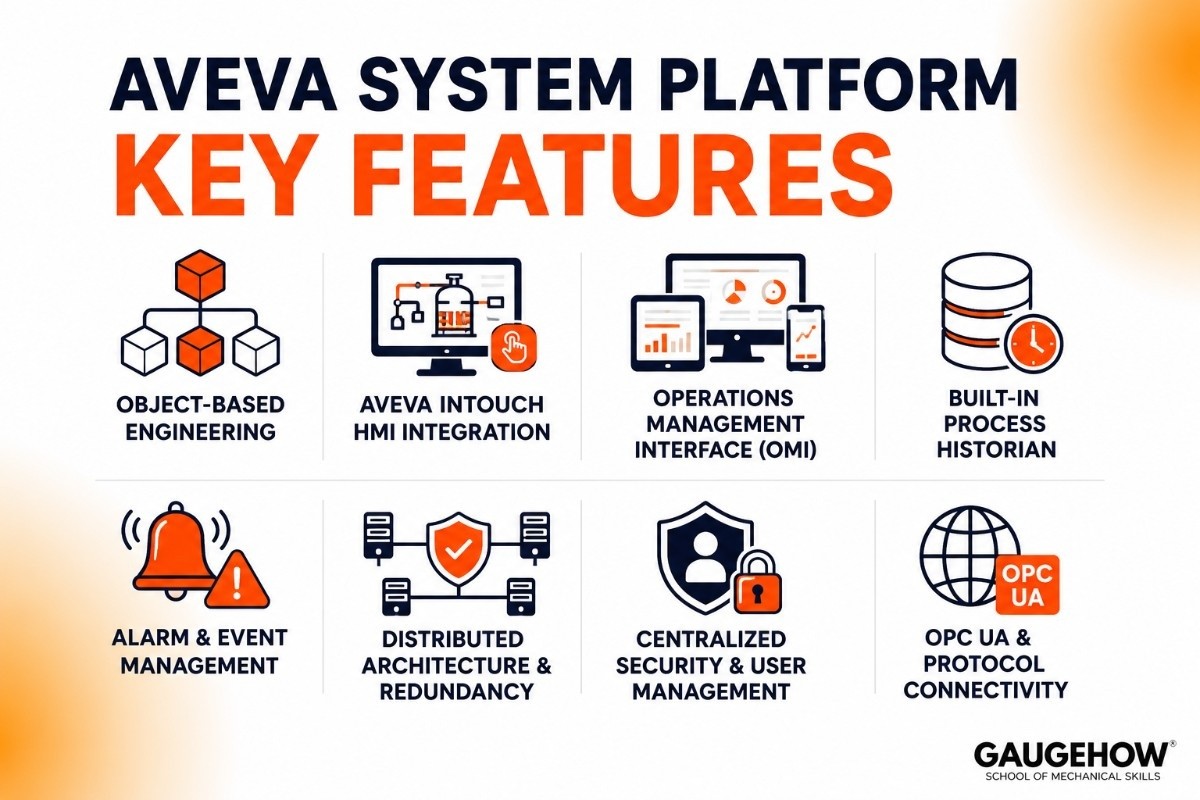
Here's a practical breakdown of the capabilities that matter most to industrial teams:
Object-Based Engineering with Galaxy Repository
Every asset in your plant is modeled as an 'object' stored in a centralized Galaxy database. Change a pump template once, and every pump in every plant that inherits from it updates automatically. This is the feature that makes System Platform genuinely scalable in a way that traditional SCADA systems are not.
AVEVA InTouch HMI Integration
System Platform ships with AVEVA InTouch HMI, widely regarded as the industry's most mature HMI runtime. InTouch provides the visualization layer — the screens operators actually watch.
It supports high-performance HMI design, alarm management, and mobile access. You can run InTouch as a standalone tool, but its full power emerges when paired with the System Platform object model.
Operations Management Interface (OMI)
OMI is the newer, responsive visualization layer built on HTML5. It's designed to give consistent operator experiences across desktop, tablet, and large display boards without custom development. Think of it as InTouch for the modern, multi-device plant floor.
Built-in Process Historian
AVEVA Historian (included in the platform) collects, compresses, and stores time-series data from thousands of I/O points. It's not just a data logger — it supports data contextualization, compliance-grade editing with full audit trails, and integration with analytics tools like Power BI, Seeq, and AVEVA's own analytics suite.
Alarm and Event Management
The platform includes an enterprise-wide alarm management system that spans all connected sites. Alarms are tied to objects, so they inherit context automatically. You get alarm shelving, suppression, rationalization tools, and reporting — all out of the box rather than bolted on.
Distributed Architecture and Redundancy
System Platform is designed for distributed topologies: Application Object Servers (AOS), Platform Servers, and Historians can be distributed across sites with built-in failover and redundancy.
This is critical for utilities, pipelines, and facilities where downtime is not acceptable.
Centralized Security and User Management
Role-based security, Active Directory integration, node-to-node TLS encryption, and full audit logging are native features. In regulated industries like pharma and food & beverage, this matters enormously for compliance.
OPC UA and Protocol Connectivity
System Platform connects to virtually any industrial device through OPC DA/UA, Modbus, PROFIBUS, HART, DDE, and a library of vendor-specific drivers. It also supports REST APIs and modern IT protocols, which is increasingly important as OT/IT convergence accelerates.
Pricing — What You'll Actually Pay
AVEVA does not publish list prices publicly, which is a source of genuine frustration for buyers. That said, here's the honest picture based on publicly available information and industry reports:
Tier / Plan | Best For | Pricing Model | Key Limits |
AVEVA Flex Starter | Small-to-mid sites, single location | Subscription (annual) | Limited I/O points; fewer redundancy options |
AVEVA Flex Professional | Multi-site manufacturers, MES users | Subscription (annual or 3-year) | Full OMI, Historian, InTouch HMI included |
AVEVA Flex Enterprise | Global operations, regulated industries | Custom / Enterprise Agreement | Unlimited tags, full redundancy, cloud connect |
Perpetual License (legacy) | Existing Wonderware customers migrating | One-time + annual maintenance | Available but being phased out for new customers |
Free Trial / Developer Edition | Evaluation and development only | Free (time-limited / non-commercial) | Non-production use; full feature access |
Ballpark cost: Realistic entry-level deployments typically start in the $20,000–$50,000 USD range for software licensing alone, excluding implementation, hardware, and training.
Mid-to-large enterprise deployments regularly reach $200,000–$500,000+. AVEVA Flex (introduced to simplify licensing) packages the full portfolio into a single subscription.
Free Trial: Yes — AVEVA offers a free Developer / Evaluation version of System Platform that gives full feature access for non-production use. This is genuinely useful for evaluation and for system integrators building and testing configurations before deployment.
AVEVA System Platform download: Available through the AVEVA Customer Portal and Developer Network after registration. AVEVA also provides an AVEVA System Platform 2026 Beta for community members, accessible via the AVEVA Heroes HQ program.
Pros & Cons — An Honest Assessment
We've reviewed community forums, Gartner Peer Insights, industry evaluators, and system integrators to compile this balanced view. Vendor pages never show you the cons. We will.
✅ What Works Well | ⚠️ Watch Out For |
Object-based model dramatically reduces configuration time on large projects | High total cost of ownership — licensing, SI fees, and training add up quickly |
InTouch HMI is battle-tested — extremely reliable in production environments | Requires specialized system integrators for most implementations; not DIY-friendly |
Scales from a single plant to hundreds of global sites on one platform | Desktop-centric UI — mobile experience (without OMI) can feel dated |
Excellent compliance features for pharma, food & bev, and regulated industries | Complex licensing structure; Flex helps, but pricing transparency is still limited |
Native redundancy and high-availability architecture out of the box | Steep learning curve for engineers new to the Galaxy object model |
Strong OPC UA/DA support plus a wide driver library for legacy devices | On-premise architecture adds infrastructure burden for smaller organizations |
Active development roadmap with cloud, IIoT, and digital twin capabilities | Cloud-native features are still maturing compared to newer cloud-first platforms |
Who Is AVEVA System Platform Best For?
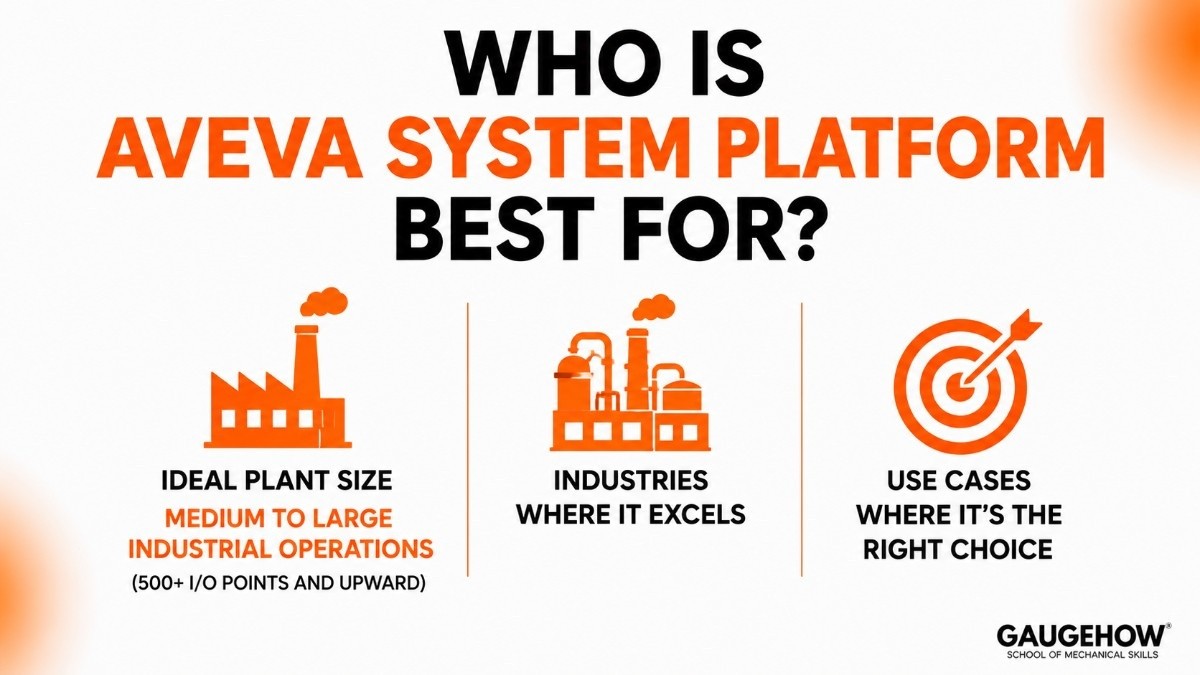
This platform genuinely shines in specific situations. It's not the right tool for everyone, and knowing that upfront saves time and money.
Ideal Plant Size
Medium to large industrial operations — typically 500+ I/O points and upward. At smaller scales, the setup complexity and cost rarely justify the capability. For single-machine HMI or small standalone SCADA, simpler tools like AVEVA Edge or third-party options are more practical.
Industries Where It Excels
• Oil & gas — upstream, midstream, and downstream pipeline SCADA
• Water and wastewater treatment — multi-site monitoring and SCADA compliance
• Pharmaceutical and life sciences — FDA 21 CFR Part 11, audit trails, batch control
• Food and beverage manufacturing — OEE, batch management, multi-line control
• Power generation and utilities — grid management, distributed site control
• Chemical processing — continuous process control and historian integration
• Mining and minerals — remote site monitoring, mobile equipment integration
Use Cases Where It's the Right Choice
1. Multi-site standardization: You need 15 plants to share a common engineering model, display standards, and KPIs.
2. Brownfield modernization: You're replacing aging DCS/SCADA with a modern platform while keeping existing PLC infrastructure.
3. OT/IT integration: You need to push real-time process data into SAP, Oracle, or a cloud analytics platform reliably.
4. Regulated manufacturing: You need compliant batch records, audit trails, and electronic signatures built into the control layer.
Integrations — What It Connects To
One of System Platform's genuine strengths is its integration reach. Here's what it connects to natively or with minimal configuration:
ERP Systems
• SAP S/4HANA and SAP MII — bi-directional production order and quality data exchange
• Oracle ERP Cloud and Oracle Manufacturing
• Microsoft Dynamics 365 — via REST API or middleware
MES and Production Systems
• AVEVA MES (Batch Management, Production Management) — native deep integration
• Rockwell Plex, Epicor, and other third-party MES via OPC UA or REST
• LIMS (Laboratory Information Management Systems) — common in pharma deployments
Sensors, PLCs, and Field Devices
• Allen-Bradley PLCs (Rockwell) — via Ethernet/IP and native drivers
• Siemens S7 and TIA Portal PLCs
• Schneider Electric Modicon — native support given AVEVA's Schneider ownership
• ABB, Emerson DeltaV, Honeywell Experion — via OPC UA
• IoT sensors — via MQTT, REST, or AVEVA Edge as the gateway
Analytics and Cloud
• AVEVA PI System (OSIsoft) — tight integration; both are now within the AVEVA portfolio
• Microsoft Azure IoT Hub and Azure Data Explorer
• AWS IoT Core and Amazon Kinesis — via AVEVA Cloud Connect
• Power BI, Tableau, Seeq — for operational analytics and reporting
Deployment Options — Cloud, On-Prem, Edge, and Brownfield
On-Premises (Traditional)
The most common deployment model for existing customers. Servers run in the plant network or local data center, giving maximum control over security and latency.
Recommended for regulated industries or operations with strict network segmentation requirements. The Wonderware System Platform migration path (from older versions) is well-documented for brownfield upgrades.
Cloud-Connected (Hybrid)
System Platform can push data to AVEVA Cloud, AWS, or Azure through AVEVA Connect and AVEVA Insight. The on-premises layer handles real-time control while the cloud receives historical data for analytics, reporting, and remote monitoring.
This hybrid model is increasingly the default for new deployments in 2026.
Edge
AVEVA Edge (the renamed InduSoft Web Studio) acts as a lightweight SCADA/HMI runtime for edge devices — panel PCs, embedded Linux systems, and IoT gateways. It integrates with System Platform to provide a connected hierarchy from machine-level HMI up to enterprise visualization.
Brownfield-Readiness
System Platform was purpose-built for brownfield environments. Its driver library (DAServer framework) supports legacy protocols going back decades.
Organizations running aging Wonderware InTouch standalone deployments can migrate incrementally, converting screens and tags to the object model without a full rip-and-replace.
Alternatives — AVEVA vs the Competition
Choosing industrial software is a long-term commitment. Here's an honest comparison of the most relevant alternatives:
Tool | Best For | Pricing | vs AVEVA |
Ignition (Inductive Automation) | Mid-size manufacturers wanting modern, flexible SCADA | From ~$3,500/server (unlimited tags, one-time) | Far lower cost; simpler to deploy; more open architecture. Less mature enterprise redundancy and historian vs AVEVA. |
Siemens WinCC / TIA Portal | Siemens PLC-heavy shops, automotive, machine builders | Varies; often bundled with Siemens hardware | Tighter Siemens PLC integration; steeper learning curve for non-Siemens ecosystems. AVEVA more vendor-neutral. |
Rockwell FactoryTalk View | Allen-Bradley / Rockwell PLC environments | Subscription or perpetual; similar price tier to AVEVA | Excellent A-B integration; less suitable for multi-vendor environments. AVEVA wins on multi-site scalability. |
GE / Emerson iFIX & CIMPLICITY | Utilities, power gen, large process industries | Enterprise pricing, varies by configuration | Strong in power and utilities. AVEVA System Platform generally considered more scalable for complex multi-site. |
Wonderware Online (AVEVA Insight) | Smaller ops wanting cloud-first SCADA without on-prem | SaaS subscription from ~$500/month | Lighter, faster to deploy, but lacks the depth of System Platform for complex control requirements. |
AVEVA vs Ignition SCADA is the most common comparison question, and for good reason. Ignition is significantly cheaper, easier to deploy, and has a vibrant developer community.
AVEVA System Platform wins on enterprise-grade redundancy, regulatory compliance features, and proven scale at 100+ site deployments. If you need FDA compliance or multi-continent standardization, AVEVA. If you want to move fast and keep costs down, Ignition deserves a serious look.
Frequently Asked Questions
Is the AVEVA System Platform cloud-based?
AVEVA System Platform is mainly an on-premises industrial automation platform. However, it also supports hybrid cloud deployment through cloud integrations, allowing businesses to connect on-site systems with cloud-based monitoring and analytics.
What is the difference between Wonderware and AVEVA System Platform?
There is no major difference in the software itself. Wonderware was rebranded as AVEVA System Platform after AVEVA acquired it, so both refer to the same trusted industrial automation platform.
AVEVA System Platform vs Ignition SCADA: Which is better?
AVEVA System Platform is better for large-scale enterprise operations, compliance-heavy industries, and advanced redundancy needs. Ignition SCADA is often preferred for lower cost, faster deployment, and greater flexibility.
Is AVEVA InTouch HMI the same as AVEVA System Platform?
No. AVEVA InTouch HMI is the visualization interface, while AVEVA System Platform is the full industrial automation framework that manages data, alarms, and system control.
How can I download AVEVA System Platform?
You can download AVEVA System Platform through AVEVA’s official customer and developer portals. Trial versions are available for evaluation and learning purposes.
Does AVEVA System Platform support OPC UA?
Yes, it fully supports OPC UA for secure and reliable communication between industrial devices, systems, and applications.
Final Verdict — Is AVEVA System Platform Worth It?
AVEVA System Platform is genuinely impressive software. The object-based architecture, enterprise-scale historian, and industrial compliance features are difficult to match at the same depth. For complex, multi-site operations in regulated industries, it's often the most defensible choice.
The honest catch: it's expensive, complex to implement, and typically requires an experienced system integrator. If you're a smaller operation looking for quick time-to-value, you may find the platform over-engineered for your needs.
The right question isn't 'Is AVEVA System Platform good?' — it clearly is. The right question is 'Is it the right fit for our scale, budget, and team?' If you have the resources to implement it properly, it will almost certainly pay for itself.
AVEVA System Platform helps industries monitor operations, improve efficiency, and make better decisions with real-time data and smarter system control.