Product Design Engineer Career Roadmap: Step by Step Guide
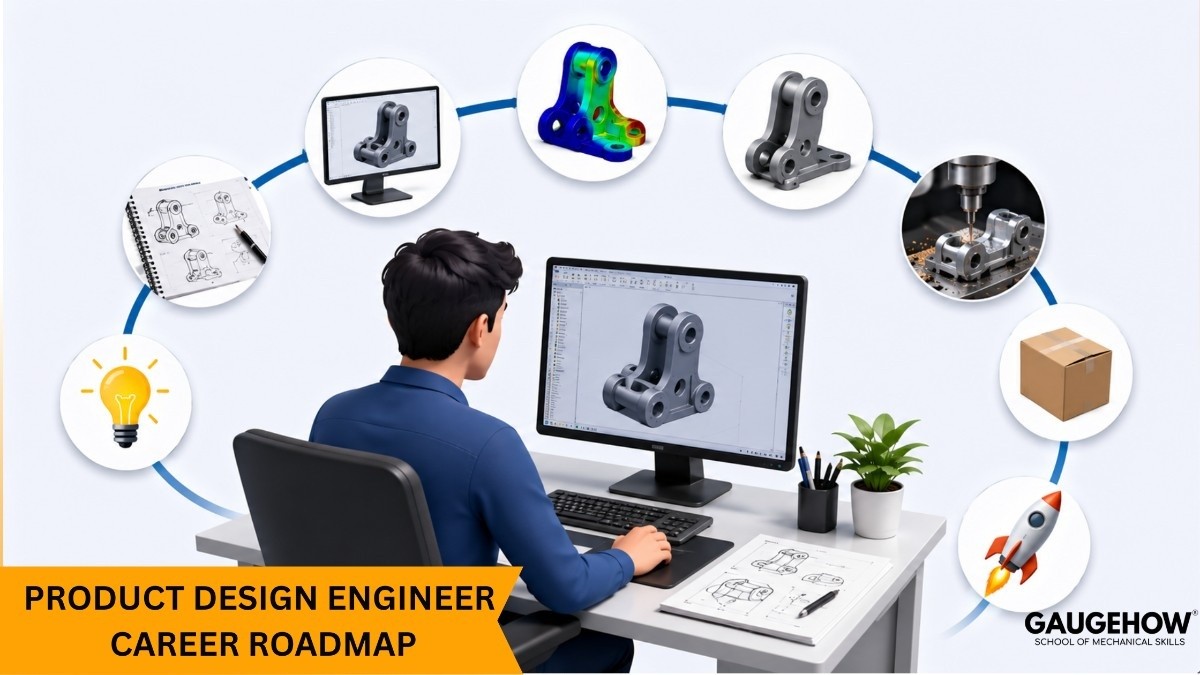
Every physical product you own, from a water bottle to a power tool, went through a product design engineer's hands before it reached a store shelf.
This role sits at the intersection of creativity, engineering, and manufacturing, and it rewards people who can take an idea all the way from a rough sketch to a part that actually works, ships, and holds up in the real world.
If you want a clear product design engineer career roadmap for 2026, this guide from GaugeHow walks through it step by step.
What Does a Product Design Engineer Do?
A product design engineer takes a product concept and turns it into a manufacturable, testable design. That means building 3D CAD models, choosing the right materials, running basic simulations to check strength or thermal performance, and working with manufacturing teams to keep the design cost effective and producible at scale.
Unlike a pure mechanical design engineer who might focus on a single component or system, a product design engineer usually owns the full product, from early concept sketches through prototyping to the final production release.
Step 1, Build a Strong Engineering Base
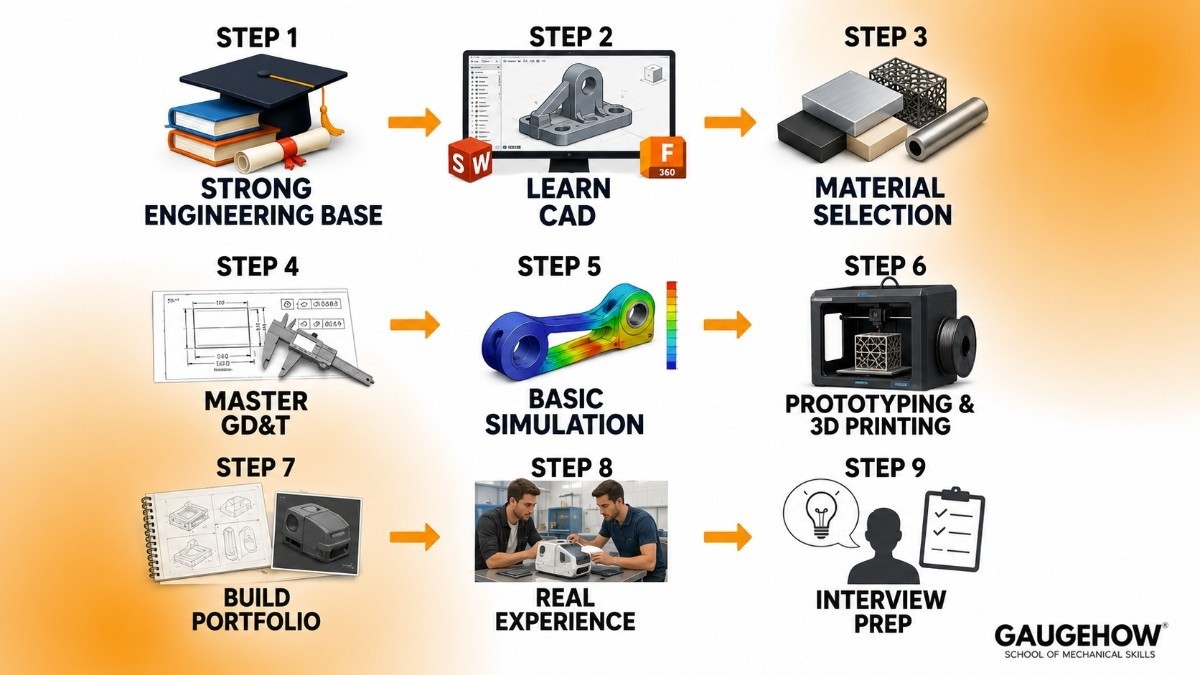
A bachelor's degree in mechanical, industrial, or product design engineering is the most common starting point.
During your degree, focus on materials science, manufacturing processes, and basic mechanics, since these subjects directly shape how practical your product designs will be later.
This foundation is what lets you make real tradeoffs between cost, strength, and manufacturability instead of just following a checklist.
Step 2, Learn CAD for Product Design
CAD skill is non negotiable for this role, and the right tool depends on the type of product you want to design.
SolidWorks is the most widely used tool for product design across consumer goods, industrial equipment, and machinery. Our SolidWorks 2024 course covers part modeling, assemblies, and production ready drawings.
Fusion 360 is a strong choice for product designers who want CAD, basic simulation, and CAM in one connected workflow, which is common in startups and smaller product teams. Covered in our Fusion 360 course.
Learn one tool deeply before adding a second. Employers care far more about whether you can take a product from a sketch to a print ready model than how many tools you have briefly touched.
Step 3, Learn Material Selection
Choosing the right material is one of the most underrated skills in product design. The same part can succeed or fail in the market depending on whether it is made from the right plastic, metal, or composite for its cost target and use case.
Our Smart Materials Science course is a useful starting point for understanding how modern materials behave and where they fit into real product decisions.
Step 4, Master GD&T for Manufacturable Designs
Geometric Dimensioning and Tolerancing is how a product design engineer communicates tolerances that a manufacturer can actually build and inspect consistently.
Skipping this step is one of the most common gaps in fresh graduate resumes, which makes it one of the easiest ways to stand out. Our GD&T and Engineering Graphics course is built specifically to close this gap before you start applying for roles.
Step 5, Add Basic Simulation Skills
Product design engineers rarely run deep simulations themselves, but knowing enough to check a design before sending it to a dedicated analysis team saves real time and builds trust with your team.
Our FEA with ANSYS course covers structural basics, while our Autodesk CFD course is useful if your product involves airflow, cooling, or fluid behavior, such as electronics enclosures or HVAC components.
Step 6, Learn Prototyping and 3D Printing
Modern product design moves fast because of rapid prototyping. Being able to 3D print a quick test version of your design, check fit and function, and iterate within days instead of weeks is now a baseline expectation, not a bonus skill.
Our 3D Printing course covers how additive manufacturing fits into a real product development cycle, from early concept models to functional prototypes.
Step 7, Build a Portfolio That Shows the Full Product Journey
Unlike a portfolio that only shows finished CAD models, a strong product design engineer portfolio shows the full journey: the original problem, early sketches or concept options, material and manufacturing decisions, a prototype iteration or two, and the final production ready design.
This tells a hiring manager you understand tradeoffs, not just software commands.
Step 8, Get Real Product Experience
An internship on an active product team is the fastest way to understand how design decisions get made under real constraints like cost targets and launch deadlines.
If a formal internship is not available, take on a self directed product project, from concept through a working prototype, and document every decision along the way. This is exactly what interviewers want to hear about.
Step 9, Prepare for Product Focused Interviews
Product design engineer interviews usually test three things.
First, how you approach a product problem from scratch, including early tradeoffs.
Second, how you reason about materials and manufacturing constraints.
Third, how you handle feedback and iterate a design after a prototype fails a test. Practice with real interview questions on the Interview Q&A Hub before you walk into your first interview.
Product Design Engineer Career Roadmap: Career Growth by Stage
Stage | Experience | What Changes |
|---|---|---|
Junior Product Design Engineer | 0 to 2 years | Learning CAD, materials, and basic DFM under supervision |
Product Design Engineer | 2 to 5 years | Owns full product designs, coordinates with manufacturing and suppliers |
Senior Product Design Engineer | 5 to 8 years | Leads design reviews, drives material and cost decisions across a product line |
Lead or Principal Product Design Engineer | 8 plus years | Sets design standards, technical authority across multiple products |
Product Design Manager | 8 plus years, people track | Leads a design team, manages resourcing and product roadmaps |
Around the 5 to 8 year mark, most product design engineers choose a direction. The individual contributor path means going deeper into a specific product category or material domain and becoming the internal expert.
The management path means moving into leading a design team and shaping the broader product roadmap. Both build on the same core roadmap.
Product Design Engineer Career Roadmap: Salary Expectations in India
Salary figures vary by source, city, and company, but the general pattern across recent salary data is consistent:
Career Stage | Approximate Annual Salary (India) |
|---|---|
Fresher, 0 to 2 years | 3 to 6 LPA |
Mid level, 2 to 5 years | 6 to 12 LPA |
Senior, 5 to 8 years | 12 to 20 LPA |
Lead or Principal, 8 plus years | 20 LPA and above |
Product design engineers who combine strong CAD skills with materials knowledge, GD&T, and basic simulation tend to land at the higher end of each band, especially in consumer electronics, EV, and industrial product companies.
FAQ: Product Design Engineer Career Roadmap
Q: How is a product design engineer different from a mechanical design engineer?
A: A mechanical design engineer typically focuses on a specific component, system, or assembly. A product design engineer usually owns the full product journey, from concept through prototyping to production, and works closely with material, manufacturing, and sometimes industrial design teams.
Q: Do I need to know 3D printing to become a product design engineer?
A: Not as a manufacturing method for every product, but understanding how to prototype quickly with 3D printing is now a standard part of the product design workflow, and most teams expect at least basic comfort with it.
Q: Is a design degree required, or is an engineering degree enough?
A: An engineering degree is enough for most product design engineer roles, especially in mechanical or industrial engineering. A design specific degree can help for consumer facing product roles but is not a strict requirement.
Q: What matters more for hiring, CAD skill or material knowledge?
A: Both matter, but material and manufacturing knowledge is what separates a strong product design engineer from someone who can only operate CAD software. Employers notice candidates who can explain why they chose a specific material or process.
Q: How long does it take to become job ready as a product design engineer?
A: With focused practice, most graduates can build a solid, interview ready portfolio in 6 to 12 months if they combine CAD, materials, GD&T, and at least one complete concept to prototype project.
Conclusion
A product design engineer career roadmap comes down to owning the full journey: strong CAD skills, real material and manufacturing knowledge, GD&T fluency, and comfort with rapid prototyping.
Build a portfolio that shows a complete product story, not just finished models, and the path from fresher to senior product design engineer becomes far more predictable.
Start Your Product Design Engineer Roadmap With GaugeHow
Explore the full Design Engineer career track on GaugeHow for a structured path through CAD, materials, GD&T, simulation, and prototyping courses built for exactly this role.
CAD-CAM-CAE Work Platform
Find or Post CAD, CAM and CAE freelance projects, full-time jobs and Internships.
GaugeHow is the platform built for core engineering work. Whether you need a freelancer for a CAD project, a full-time hire, or an engineering intern,post it here and get matched with the right person.