C3 AI
c3.ai

C3 AI: Complete Guide to the Enterprise AI Platform
Artificial intelligence has moved far beyond chatbots and consumer applications. Today, businesses use AI to predict equipment failures, optimize supply chains, detect fraud, and improve operational efficiency. One of the platforms helping organizations deploy AI at scale is C3 AI.
Whether you're a student researching enterprise AI or a business evaluating AI software, this guide explains what C3 AI is, how it works, its pricing, features, deployment options, integrations, and alternatives.
What Is C3 AI?
C3 AI is an enterprise AI platform that helps organizations build, deploy, and manage artificial intelligence applications at scale.
Founded by entrepreneur Thomas Siebel, C3 AI provides software that allows businesses to combine data from multiple sources, create AI models, and deploy AI-powered applications across industries such as manufacturing, energy, healthcare, defense, and financial services.
Instead of building AI systems from scratch, organizations can use C3 AI to accelerate development and gain insights from operational data.
How Does C3 AI Work?
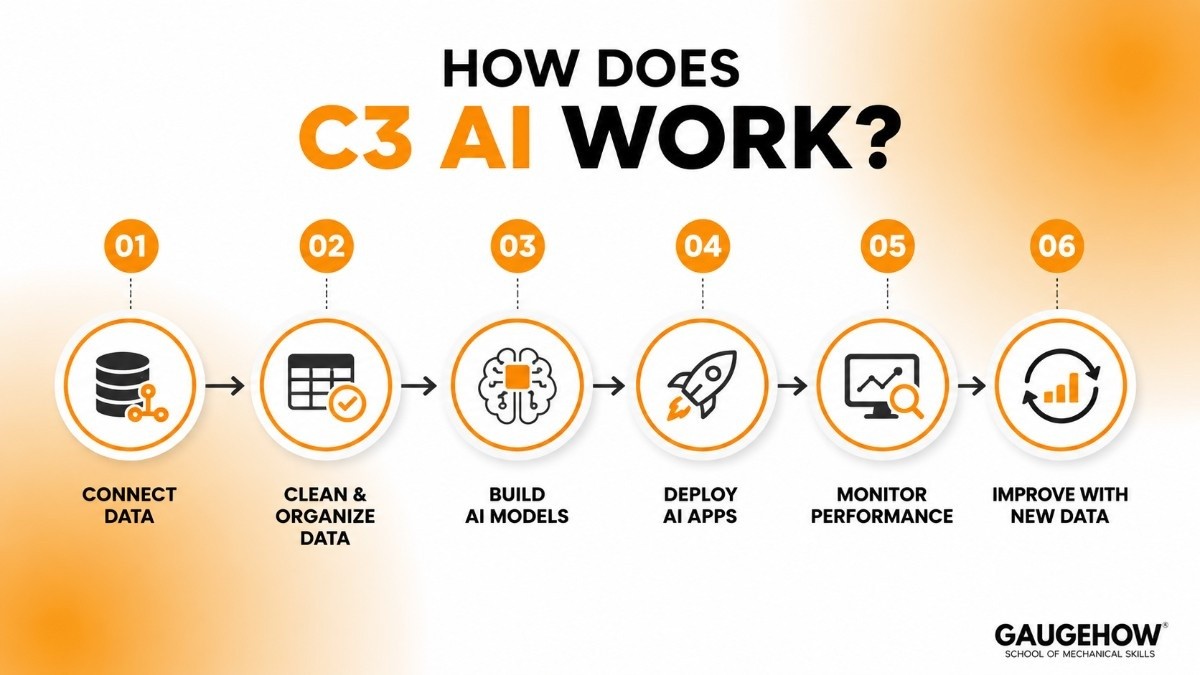
The platform follows a straightforward process:
Connect data from enterprise systems.
Clean and organize the data.
Build AI and machine learning models.
Deploy AI applications.
Monitor performance and predictions.
Continuously improve models using new data.
For example, a manufacturer can use C3 AI to predict machine failures before they cause production downtime.
Key Features of C3 AI
1. Enterprise AI Development
Build and deploy AI applications without creating everything from scratch.
2. Predictive Analytics
Identify future risks, failures, and opportunities using machine learning.
3. Data Integration
Connect data from ERP, CRM, MES, IoT, and cloud systems.
4. Machine Learning Automation
Simplify model training, deployment, and monitoring.
5. Predictive Maintenance
Monitor equipment health and reduce unexpected downtime.
6. Supply Chain Optimization
Improve forecasting, inventory planning, and logistics operations.
7. AI Application Suite
Access pre-built applications for common business use cases.
8. Security and Governance
Manage data access, compliance, and model governance across the organization.
C3 AI Pricing
One of the most searched topics is C3 AI pricing.
Unlike many SaaS products, C3 AI does not publicly disclose standard pricing plans. Most deployments are customized based on organizational requirements.
Pricing Typically Depends On
Number of users
Data volume
AI applications deployed
Cloud infrastructure usage
Industry requirements
Support and consulting services
Typical Pricing Model
Component | Pricing Basis |
|---|---|
Software License | Subscription |
AI Applications | Usage-based |
Users | Per user or enterprise |
Cloud Resources | Consumption-based |
Support Services | Custom |
Free Trial Availability
Public free trials are generally limited. Most organizations request a product demonstration or consultation.
Because C3 AI targets enterprise customers, pricing is usually customized rather than fixed.
C3 AI Earnings and Market Interest
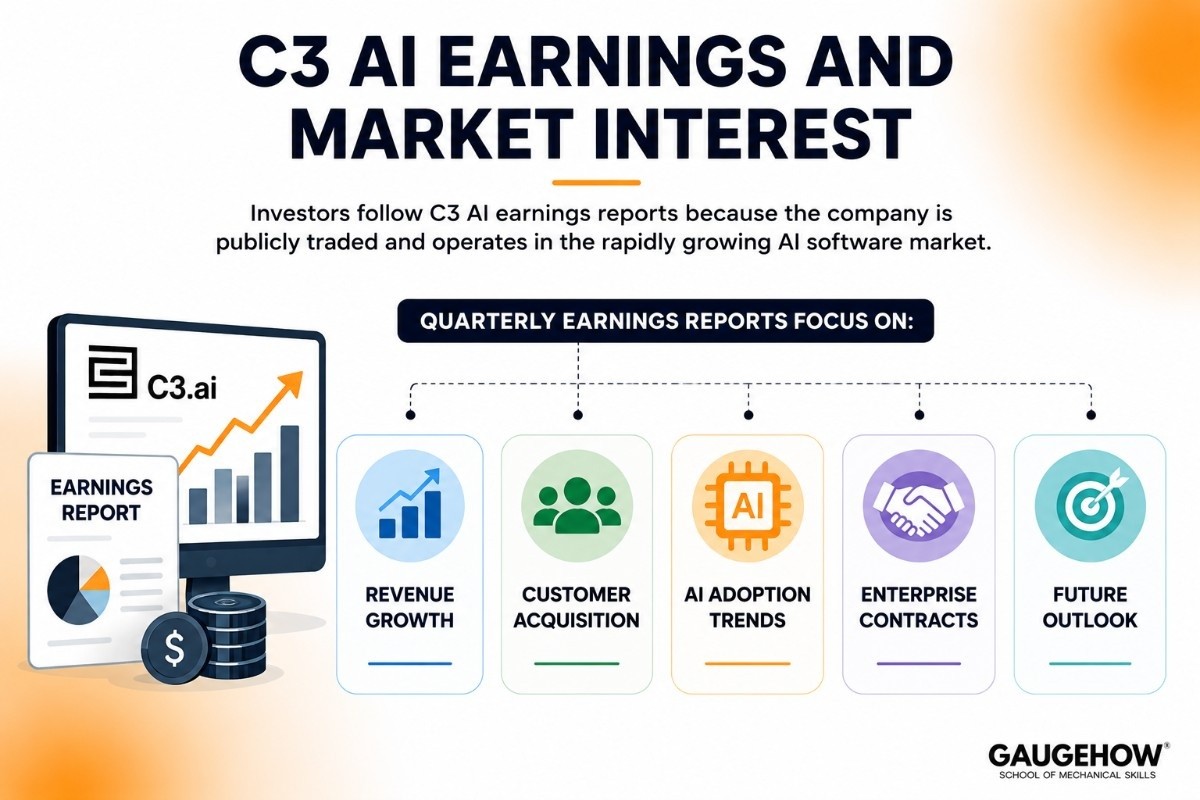
Many investors follow C3 AI earnings reports because the company is publicly traded and operates in the rapidly growing AI software market.
Quarterly earnings reports often focus on:
Revenue growth
Customer acquisition
AI adoption trends
Enterprise contracts
Future business outlook
For investors, earnings announcements provide insight into the company's financial performance and market position.
Pros and Cons of C3 AI
Pros
✅ Built specifically for enterprise-scale AI
✅ Strong data integration capabilities
✅ Supports multiple industries
✅ Includes pre-built AI applications
✅ Scalable cloud architecture
✅ Supports predictive maintenance and analytics
Cons
❌ Pricing is not publicly transparent
❌ Enterprise deployments can be complex
❌ May require specialized AI expertise
❌ Smaller companies may find it expensive
❌ Implementation timelines can be longer than simple SaaS tools.
C3 AI Integrations
A major advantage of C3 AI is its ability to connect with enterprise systems.
ERP Systems
SAP
Oracle ERP
Microsoft Dynamics 365
CRM Platforms
Salesforce
Microsoft Dynamics CRM
MES Platforms
Siemens Opcenter
Rockwell FactoryTalk
AVEVA MES
Cloud Platforms
Microsoft Azure
Amazon Web Services (AWS)
Google Cloud
Industrial Data Sources
OPC UA
MQTT
Industrial IoT sensors
SCADA systems
This allows organizations to build AI models using data from multiple business functions.
Deployment Options
Cloud Deployment
The most common deployment method, supporting Azure, AWS, and Google Cloud.
Hybrid Deployment
Combines cloud infrastructure with on-premise systems.
On-Premise Deployment
Available for organizations with strict security or compliance requirements.
Brownfield Readiness
C3 AI can integrate with existing enterprise software and industrial equipment, reducing the need for major infrastructure changes.
This is particularly useful for organizations running legacy systems.
C3 AI Login and User Access
Users access the platform through a secure web-based login environment.
Access can be configured based on roles such as:
Data scientists
Engineers
Business analysts
Plant managers
Executives
Role-based permissions help protect sensitive business data.
Best For
C3 AI is not a tool for every organization. Here is an honest breakdown of where it fits.
Ideal profile
• Large enterprises with 1,000+ employees, dedicated data science or AI teams, and complex multi-system data environments. The platform pays off most when the problem is genuinely hard.
• Regulated industries — defense, financial services, healthcare, utilities, and pharmaceuticals — where auditability and governance are non-negotiable.
• Organizations with existing hyperscaler relationships (AWS, Azure, or GCP). C3 AI deploys within your cloud, so having existing infrastructure there simplifies procurement and security review.
• Manufacturing, oil and gas, and utilities where C3 AI has the deepest pre-built application libraries and the most reference customers.
• Companies looking to move from AI experimentation to production who have tried internal builds and run into scaling, governance, or maintenance walls.
Probably not the right fit
• Small and mid-size businesses without dedicated data or engineering teams. The platform assumes significant technical capacity on the customer side.
• Companies that need something up and running in days. C3 AI deployments are measured in weeks for pilots and months for full production rollouts.
• Organizations tracking narrow, specialized use cases. If your priority is isolated trend diagnostics or standalone asset tracking, a point solution like Seeq or SparkCognition delivers ROI much faster than a full C3 AI rollout.
• Teams that prioritize transparent, predictable SaaS pricing over consumption-based flexibility.
C3 AI vs Palantir
One of the most common comparisons in enterprise AI is C3 AI vs Palantir.
Feature | C3 AI | Palantir |
Primary Focus | Enterprise AI Applications | Data Integration & Analytics |
Predictive Maintenance | Strong | Strong |
AI Model Development | Extensive | Moderate |
Government Adoption | Moderate | Very Strong |
Manufacturing Use Cases | Strong | Strong |
Data Platform Capabilities | Strong | Very Strong |
It is also vital to separate these massive enterprise data layers from plant-floor tools. While C3 AI structures data globally, engineers on the ground still rely on tools like Seeq for rapid time-series analysis and Sight Machine for discrete manufacturing data modeling.
Which Is Better?
Choose C3 AI if:
AI model deployment is a priority.
You want pre-built enterprise AI applications.
Predictive maintenance is a key use case.
Choose Palantir if:
Complex data integration is the main challenge.
Large-scale analytics projects are the focus.
Government or defense applications are important.
Alternatives to C3 AI
If C3 AI is not the right fit, consider these alternatives.
Palantir Foundry
Enterprise data integration and analytics platform.
Databricks
AI, analytics, and machine learning platform.
DataRobot
Automated machine learning and AI development platform.
IBM Watsonx
Enterprise AI and machine learning environment.
Microsoft Azure AI
Cloud-based AI services and model development tools.
Falkonry
An automated anomaly detection system that flags operational deviations without heavy data science configuration.
Frequently Asked Questions
What is C3 AI used for?
C3 AI helps businesses build AI applications for predictive maintenance, forecasting, supply chain optimization, and operational analytics.
Is C3 AI cloud-based?
Yes. C3 AI supports cloud, hybrid, and on-premise deployments depending on business requirements.
Does C3 AI integrate with ERP and MES systems?
Yes. The platform connects with ERP, MES, CRM, IoT, and industrial data systems.
C3 AI vs Palantir: Which is better?
Both platforms are powerful. C3 AI focuses more on enterprise AI applications, while Palantir is known for advanced data integration and analytics.
Is C3 AI suitable for small businesses?
C3 AI is primarily designed for enterprise organizations. Smaller companies may find the platform more complex and expensive than necessary.
Final Thoughts
C3 AI has established itself as one of the leading enterprise AI platforms by helping organizations turn large volumes of business and operational data into actionable insights.
Its strengths lie in predictive analytics, machine learning deployment, industrial AI applications, and enterprise-scale integrations. For students learning about enterprise AI, C3 AI provides a strong example of how artificial intelligence is being used in real-world industries to improve decision-making, efficiency, and business performance.
C3 AI is an enterprise AI platform that helps businesses use data, machine learning, and analytics to improve operations, and make smarter decisions.