Falkonry
Falkonry

Falkonry: Complete Guide to the Industrial AI and Time Series Analytics Platform
Industrial companies generate huge amounts of machine and sensor data every day. The challenge is turning that data into useful insights that help reduce downtime, improve reliability, and optimize operations. This is where Falkonry comes in.
Whether you're a student learning about Industrial AI or a professional exploring predictive analytics tools, this guide explains what Falkonry is, how it works, its features, pricing, deployment options, integrations, and alternatives.
What Is Falkonry?
Falkonry is an industrial AI platform that analyzes machine and sensor data to detect patterns, identify anomalies, and improve operational performance.
Founded in Silicon Valley, Falkonry focuses on helping manufacturers and industrial organizations use AI without requiring a team of data scientists. The platform analyzes time-series data from equipment and automatically finds issues that may affect production, quality, or reliability.
In simple terms, Falkonry helps companies understand what their machines are trying to tell them.
How Does Falkonry Work?
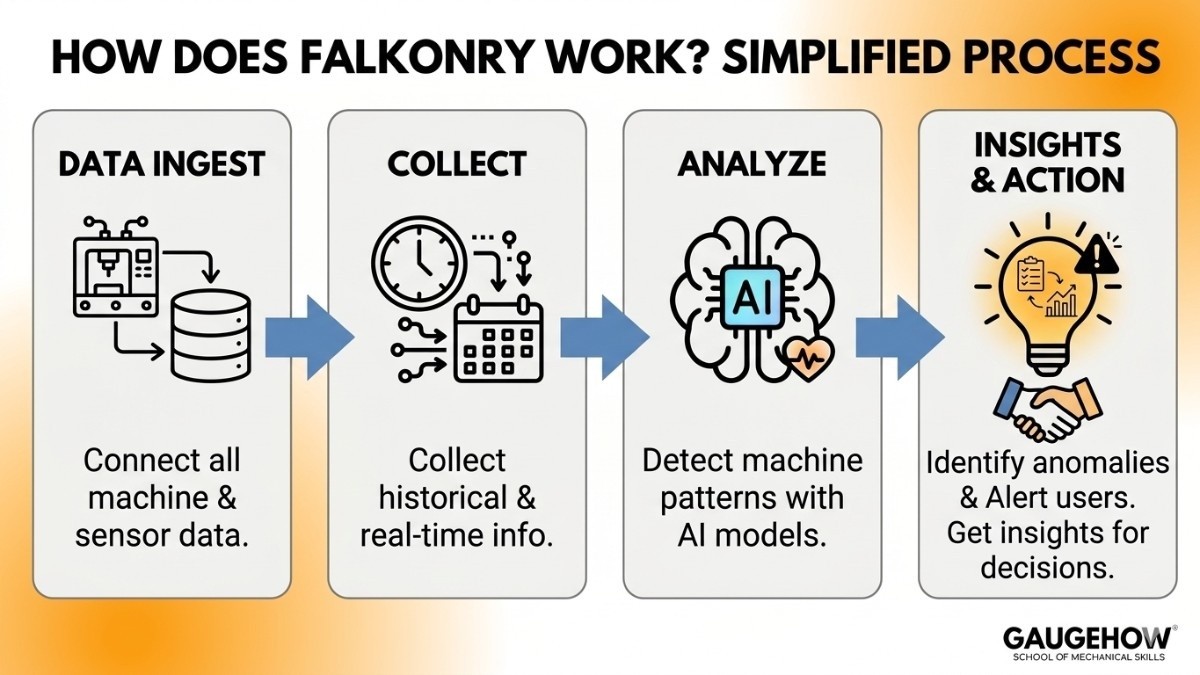
The platform follows a straightforward process:
Connect machine and sensor data.
Collect historical and real-time information.
Apply AI models to detect patterns.
Identify unusual behavior or anomalies.
Alert users about potential issues.
Support decisions with data-driven insights.
For example, if a motor starts behaving differently than normal, Falkonry can detect the change before a failure occurs.
What Is Time Series AI?
One term often associated with Falkonry is Time Series AI.
Time-series data is information collected over time, such as:
Temperature readings
Pressure values
Vibration measurements
Production rates
Energy consumption
Time Series AI analyzes these data streams to identify trends, detect anomalies, and predict future events.
This makes it especially valuable in manufacturing, energy, utilities, and process industries where equipment continuously generates operational data.
Key Features of Falkonry
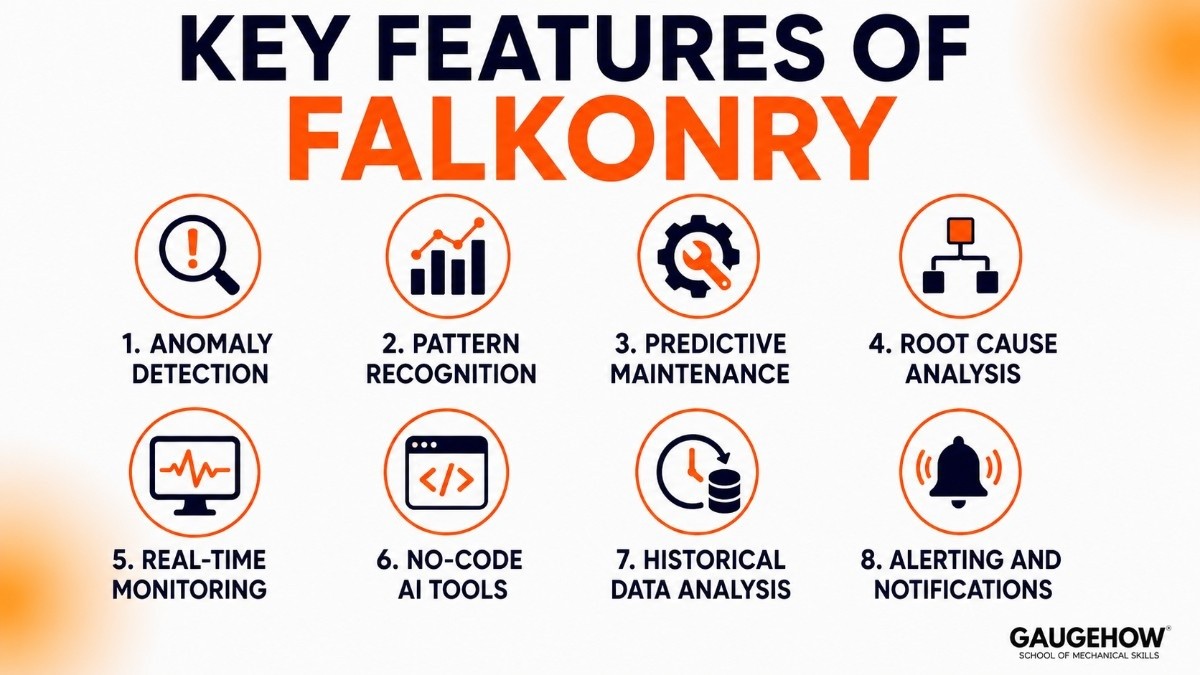
1. Anomaly Detection
Automatically identifies unusual machine behavior before it becomes a major problem.
2. Pattern Recognition
Finds hidden relationships in operational data.
3. Predictive Maintenance
Helps maintenance teams address issues before equipment failures occur.
4. Root Cause Analysis
Supports investigations into quality issues and production disruptions.
5. Real-Time Monitoring
Continuously monitors machine performance and operating conditions.
6. No-Code AI Tools
Engineers can use the platform without extensive data science knowledge.
7. Historical Data Analysis
Analyze past events to understand operational performance.
8. Alerting and Notifications
Receive notifications when abnormal patterns are detected.
Falkonry Pricing
One of the most searched topics is Falkonry pricing.
Like many industrial software vendors, Falkonry does not publicly publish detailed pricing information.
Pricing generally depends on:
Number of assets monitored
Data volume
Number of users
Deployment model
Support requirements
Typical Pricing Structure
Component | Pricing Basis |
|---|---|
Platform License | Subscription |
Users | User-based |
Assets | Equipment monitored |
Support | Optional |
Deployment | Customized |
Free Trial Availability
Most organizations begin with a demonstration, pilot project, or consultation rather than a public free trial.
Pros and Cons of Falkonry
Pros
✅ Easy-to-understand AI tools
✅ Strong anomaly detection capabilities
✅ No-code approach for engineers
✅ Works with industrial data sources
✅ Supports predictive maintenance programs
✅ Reduces dependence on data science teams
Cons
❌ Pricing is not publicly available
❌ Enterprise implementation may require planning
❌ Best results depend on data quality
❌ Advanced use cases may require AI expertise
❌ Smaller facilities may not use every feature
Falkonry Reviews
Most Falkonry reviews highlight the platform's ability to simplify industrial AI projects.
Common Positive Feedback
Easy-to-use interface
Strong anomaly detection
Good industrial focus
Useful predictive maintenance capabilities
Faster insights from operational data
Common Challenges
Learning curve for first-time AI users
Enterprise software pricing
Integration effort for complex environments
As with most industrial analytics platforms, successful deployment depends heavily on data quality and implementation strategy.
Best For
Falkonry is a specialist tool. It works best when the fit is right.
Industries where it fits well
• Manufacturing (automotive, food and beverage, semiconductors, metals) — where machines run continuously and a single unplanned stop costs thousands per hour.
• Oil and gas — compressors, pumps, and drilling equipment where early warning of a failure can prevent safety incidents.
• Defense and naval operations — ship machinery monitoring, where Falkonry has specific documented experience.
• Utilities and energy — power generation equipment, turbines, and grid infrastructure.
• Pharmaceuticals and chemicals — process industries where quality and compliance depend on tight process control.
Company size
Falkonry works best in organisations with a dedicated engineering or reliability team. You do not need a large data science department, but you do need engineers who understand the equipment and can give feedback on what the platform is detecting. Very small companies without that technical capacity may struggle to get value from the platform quickly.
Not the right fit for
• Teams looking for a quick-install, out-of-the-box dashboard. Falkonry requires setup time and engineer involvement.
• Companies that need traditional BI reporting, scheduled reports, or ERP-connected analytics. Falkonry is specifically for machine and sensor data — not business data.
• Budget-constrained teams who need transparent pricing upfront before starting an evaluation.
Falkonry Integrations
Falkonry is designed to work with existing industrial systems.
ERP Systems
SAP
Oracle ERP
Microsoft Dynamics 365
MES Platforms
Siemens Opcenter
AVEVA MES
Rockwell FactoryTalk
Industrial Systems
SCADA systems
Historians
PLCs
Industrial Protocols
OPC UA
MQTT
Modbus
Sensor Connectivity
Vibration sensors
Temperature sensors
Pressure sensors
Flow meters
Energy meters
These integrations allow companies to use existing data without replacing infrastructure.
Deployment Options
Cloud Deployment
Supports cloud-based analytics and monitoring.
On-Premise Deployment
Available for organizations with strict security requirements.
Hybrid Deployment
Combines cloud services with local infrastructure.
Brownfield Readiness
One of Falkonry's strengths is its ability to connect with existing industrial environments.
It works with:
Legacy PLCs
Existing SCADA systems
Industrial historians
Older production equipment
This reduces implementation costs and simplifies adoption.
Falkonry Login and User Access
Users access Falkonry through a secure login portal.
Role-based permissions can be assigned to:
Operators
Maintenance teams
Engineers
Supervisors
Plant managers
This helps ensure secure access to operational data.
Falkonry vs Seeq
Falkonry and Seeq are often compared because both work with industrial data.
Feature | Falkonry | Seeq |
|---|---|---|
AI-Based Anomaly Detection | Strong | Moderate |
Time Series Analytics | Strong | Strong |
Predictive Maintenance | Strong | Moderate |
Process Analysis | Moderate | Strong |
Ease of Use | High | High |
Manufacturing Focus | High | High |
Which Should You Choose?
Choose Falkonry if:
You need automated anomaly detection.
Predictive maintenance is a priority.
You want AI-driven insights with minimal data science effort.
Choose Seeq if:
Process analytics is your main focus.
Engineers need advanced trend analysis.
You work heavily with historian data.
Alternatives to Falkonry
If Falkonry is not the right fit, consider these alternatives:
Seeq
Industrial analytics and process intelligence platform.
C3 AI
Enterprise AI platform for predictive maintenance and operations.
Sight Machine
Manufacturing analytics and production intelligence platform.
AVEVA Insight
Cloud-based industrial monitoring and analytics solution.
Siemens Insights Hub
Industrial IoT and analytics platform for connected operations.
Falkonry Careers
Falkonry careers are typically focused on areas such as:
Artificial Intelligence
Machine Learning
Data Engineering
Industrial Analytics
Software Development
Customer Success
Professionals with experience in manufacturing, industrial IoT, and data science often find opportunities within the company.
Frequently Asked Questions
What is Falkonry used for?
Falkonry helps manufacturers and industrial companies analyze machine and sensor data in real time. It detects unusual patterns, predicts equipment issues, and helps teams improve reliability, efficiency, and production performance.
Is Falkonry cloud-based?
Yes. Falkonry supports cloud, on-premise, and hybrid deployments. This flexibility allows organizations to choose the setup that best fits their security, compliance, and operational requirements.
What is Time Series AI?
Time Series AI analyzes data collected continuously over time, such as temperature, pressure, vibration, and production metrics. It helps identify trends, detect anomalies, and predict potential issues before they affect operations.
Falkonry vs Seeq: Which is better?
The choice depends on your goals. Falkonry is often preferred for AI-driven anomaly detection and predictive maintenance, while Seeq is commonly used for process analytics, trend analysis, and engineering investigations.
Does Falkonry work with existing factory systems?
Yes. Falkonry can connect with ERP, MES, SCADA systems, PLCs, historians, and industrial sensors. This makes it easier for manufacturers to use existing equipment and data without major infrastructure changes.
Final Thoughts
Falkonry helps industrial organizations make better use of machine and sensor data through AI-powered analytics. Its focus on anomaly detection, predictive maintenance, and time-series analysis makes it particularly valuable for manufacturers and asset-intensive industries.
For students exploring Industrial AI, Falkonry provides a practical example of how machine learning can be applied to real-world operations.
As factories continue to adopt digital transformation initiatives, platforms like Falkonry are becoming increasingly important for improving reliability, efficiency, and decision-making.
Falkonry is an industrial AI platform that analyzes machine and sensor data to detect issues, predict failures, and improve operations in real time.