How to Become a Design Engineer
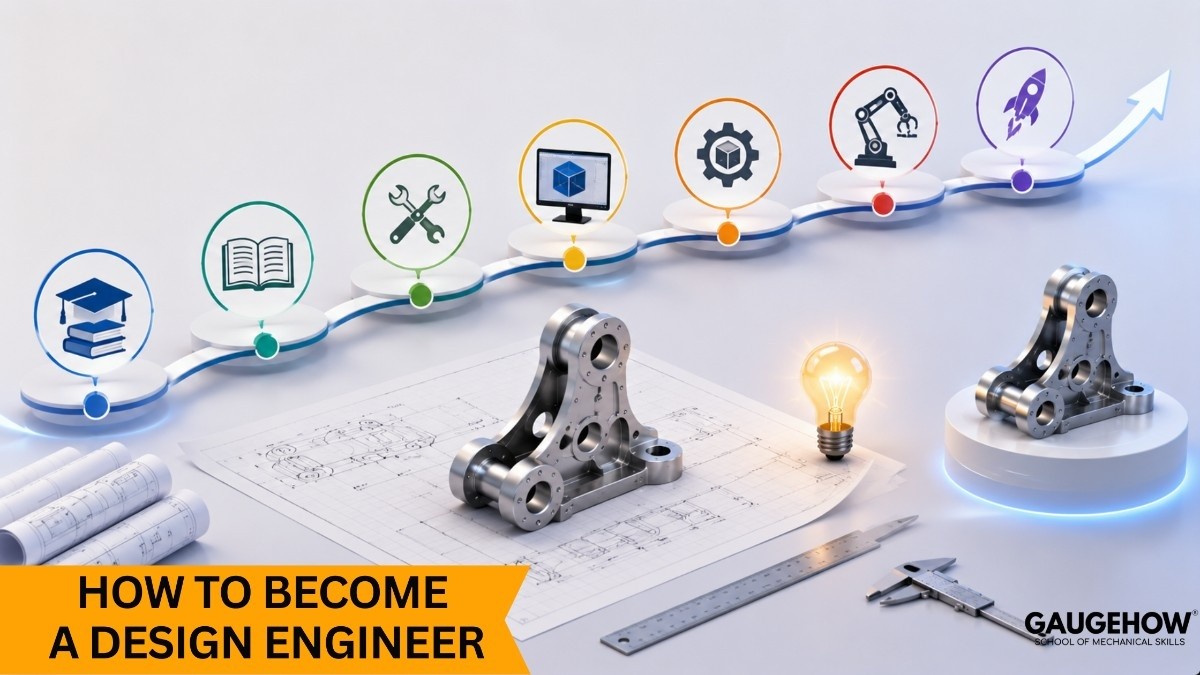
Every product you touch today the phone in your hand, the chair you're sitting on, the car parked outside went through a design engineer's desk before it reached you.
If you like the idea of turning a rough sketch into a manufacturable, tested, real-world part, design engineering is one of the most stable and well-paid paths in mechanical and product engineering.
The catch: nobody hands you a syllabus for it. This guide breaks down exactly what a design engineer does, the skills you need, and the step-by-step roadmap to get hired plus what happens after you land the job.
Who Is a Design Engineer? A Quick Definition
A design engineer takes a product idea or a customer requirement and turns it into a detailed, manufacturable design. On a typical day, that means building 3D CAD models, running tolerance and stack-up checks, creating GD&T-compliant drawings, coordinating with manufacturing on cost and feasibility, and iterating designs based on test or simulation feedback.
Design engineers work across mechanical, automotive, aerospace, electronics, and product-design industries, and the CAD tool changes by sector SolidWorks and Fusion 360 dominate product and machine design, AutoCAD is still standard for 2D and layout work, and CATIA or NX show up heavily in automotive and aerospace.
How to Become a Design Engineer: Step-by-Step
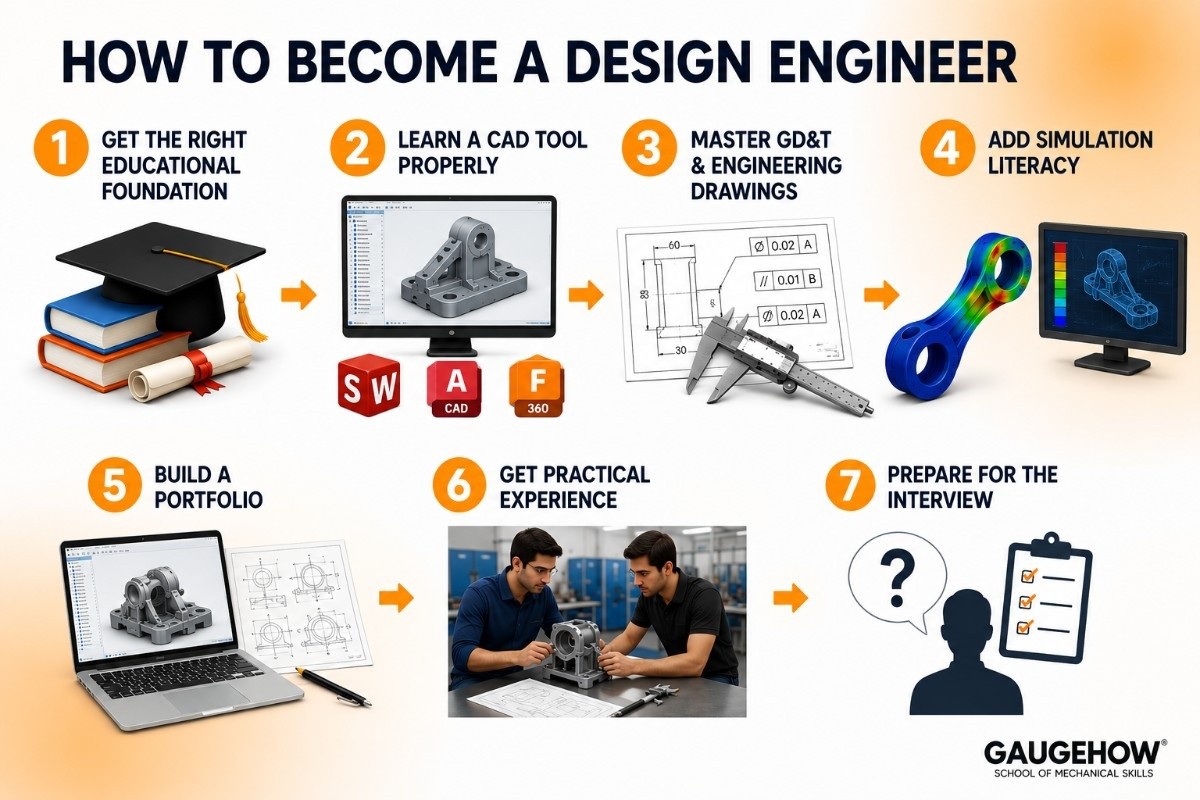
Step 1 Get the Right Educational Foundation
Most design engineer roles ask for a bachelor's degree in mechanical, automotive, production, or industrial engineering. Core subjects that actually matter on the job: engineering mechanics, materials science, machine design, and manufacturing processes.
If you're still in college, treat your coursework as the theory layer the CAD and drawing skills below are what actually get you hired.
Step 2 Learn a CAD Tool Properly (Not Just the Basics)
This is the single highest-leverage skill for a design engineer. Recruiters filter resumes on tool proficiency before anything else. Pick one tool and go deep rather than skimming five:
SolidWorks — the most requested tool for product and mechanical design roles. Our SolidWorks 2024 course covers part modeling through assemblies and drawings.
AutoCAD — still the standard for 2D layouts, fabrication drawings, and plant design. Start with the AutoCAD course.
Fusion 360 — a strong choice if you want CAD + basic simulation + CAM in one tool, especially for startups and product design roles. Covered in the Fusion 360 course.
Whichever tool you pick, don't stop at "I can draw a part." Employers test whether you can model an assembly with correct mates, generate a print-ready drawing, and defend your design intent in an interview.
Step 3 Master GD&T and Engineering Drawings
A design that can't be manufactured or inspected consistently isn't a finished design it's a sketch.
Geometric Dimensioning and Tolerancing (GD&T) is how design engineers communicate tolerances that machinists and quality teams can actually build and check against.
This is one of the most commonly missed skills among fresh graduates, and one of the fastest ways to stand out in an interview. Our GD&T and Engineering Graphics course is built specifically to close this gap.
Step 4 Add Simulation Literacy
You don't need to be a full-time analyst, but a design engineer who can run a basic stress or thermal check before sending a part to the FEA team gets trusted with bigger projects faster.
Even foundational exposure through a course like FEA with ANSYS helps you speak the same language as your simulation and quality teams and reduces design iteration cycles.
Step 5 Build a Portfolio, Not Just a Resume
Design engineering is a visual, provable skill. Two or three well-documented projects a redesigned bracket with a tolerance stack-up, an assembly with a bill of materials, a part optimized for cost or weight carry more weight than a bullet-point resume.
Include the problem, your CAD process, the drawing output, and what you'd do differently. This single change is what usually gets shortlisted candidates past the first screening call.
Step 6 Get Practical Experience Through Internships or Projects
If you can't land a formal internship, self-directed projects and freelance CAD work are a legitimate substitute what matters to employers is evidence you've taken a design from concept to a manufacturable drawing under real constraints (cost, material, tolerance).
Step 7 Prepare for the Interview Specifically
Design engineer interviews test three things: your CAD process (walk me through how you'd model this), your GD&T reasoning (why this tolerance, not a tighter one), and your problem-solving under constraints (redesign this part to cut weight by 20% without losing strength).
Practice with real questions on the Interview Q&A Hub before you walk in.
Design Engineer Career Roadmap: What Comes After You're Hired
Stage | Typical Experience | Focus |
|---|---|---|
Junior Design Engineer | 0–2 years | CAD modeling, drawings, learning DFM/DFA under supervision |
Design Engineer | 2–5 years | Owns full components/assemblies, mentors juniors, tighter DFM ownership |
Senior Design Engineer | 5–8 years | Leads design reviews, cross-functional coordination, architecture decisions |
Lead / Principal Design Engineer | 8+ years | Technical authority across projects, sets design standards |
Design Engineering Manager | 8+ years (people track) | Team leadership, resourcing, career development of engineers |
The career forks into two tracks around the 5–8 year mark: an individual contributor (IC) track, where you go deeper technically and become the go-to expert on a product line, or a management track, where you take on team leadership and planning.
Neither is a "better" path it depends on whether you want to keep designing or start leading people.
Design Engineer Salary in India: What to Expect
Salary data varies by source and city, but the pattern across major salary databases is consistent:
Level | Approximate Annual Salary (India) |
|---|---|
Fresher / Entry-level (0–2 yrs) | ₹3–6 LPA |
Mid-level (2–5 yrs) | ₹6–12 LPA |
Senior (5–8 yrs) | ₹12–20 LPA |
Lead / Principal (8+ yrs) | ₹20 LPA+ |
Mechanical design engineers in automotive and EV hubs, and those with strong CAD + GD&T + simulation combined skills, consistently land at the higher end of each band. City, employer size, and whether you specialize (aerospace, EV, automation) all move these numbers meaningfully.
FAQ: How to Become a Design Engineer
Q: Do I need a specific degree to become a design engineer?
A: A bachelor's in mechanical, production, automotive, or industrial engineering is the most common route. Some companies also hire strong CAD portfolio candidates from diploma or non-core backgrounds, especially for junior roles.
Q: Which CAD software should I learn first AutoCAD or SolidWorks?
A: If you're targeting product or mechanical design roles, start with SolidWorks. If you're aiming at 2D layout, plant, or civil-adjacent design work, start with AutoCAD. Many design engineers eventually learn both.
Q: How long does it take to become a design engineer?
A: Roughly 4 years for a degree plus 6–12 months of focused skill-building (CAD, GD&T, portfolio) and job searching. Career switchers with a strong CAD portfolio can sometimes move faster.
Q: Is GD&T really necessary, or can I learn it on the job?
A: You can learn parts of it on the job, but walking into an interview already fluent in GD&T is one of the clearest differentiators for freshers most candidates skip it, so it's an easy way to stand out.
Q: What's the difference between a design engineer and a mechanical engineer?
A: Mechanical engineering is the broader discipline; design engineering is a specialization within it (or within electrical/industrial engineering) focused specifically on turning concepts into manufacturable CAD models and drawings.
Conclusion
Becoming a design engineer comes down to three things: a solid engineering foundation, deep not surface-level CAD and GD&T skills, and a portfolio that proves you can take a design from concept to a manufacturable drawing.
Get those three right, and the roadmap from fresher to senior design engineer is well-trodden and well-paid.
Start Building the Right Skills Today
Ready to start? Explore the full Design Engineer career track on GaugeHow for a structured path through CAD, GD&T, and simulation courses built for exactly this role.
CAD-CAM-CAE Work Platform
Find or Post CAD, CAM and CAE freelance projects, full-time jobs and Internships.
GaugeHow is the platform built for core engineering work. Whether you need a freelancer for a CAD project, a full-time hire, or an engineering intern,post it here and get matched with the right person.