Design Engineer Roadmap (2026): From Fresher to Senior Engineer
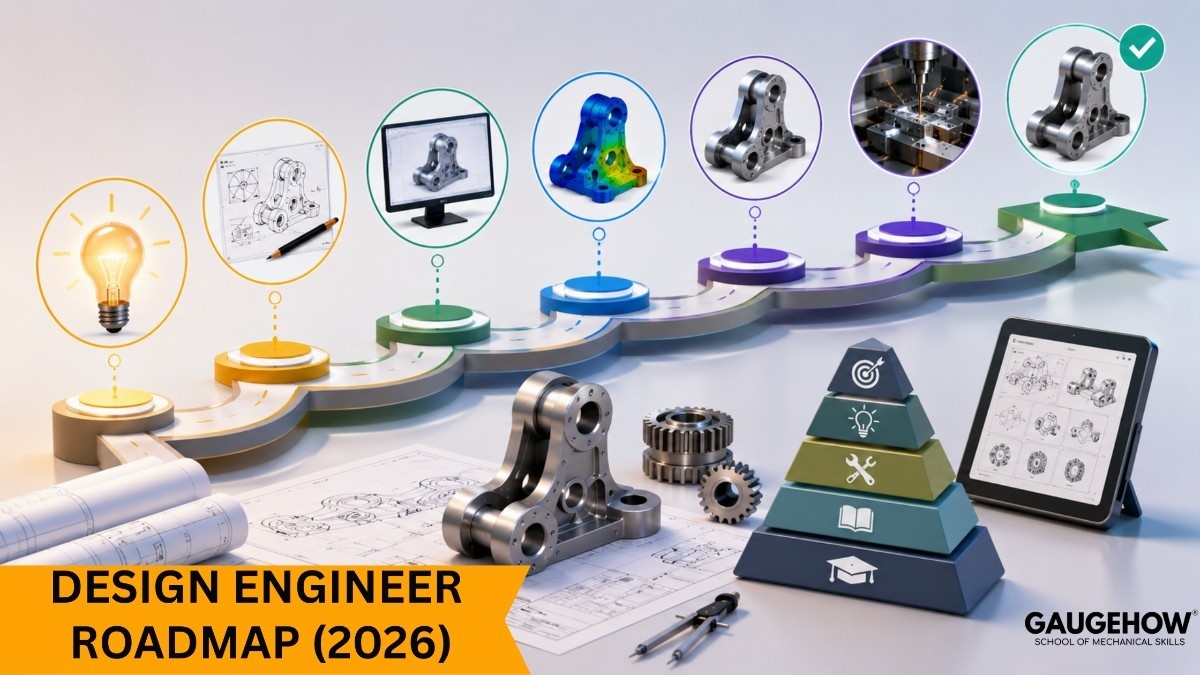
Design engineering is changing faster than most job descriptions can keep up with. AI assisted CAD, cloud based design tools, and digital twins are now part of daily work, not future concepts.
If you are trying to figure out how to become a design engineer in 2026, or where your career should head next, you need a roadmap that reflects where the field actually is today, not one written five years ago.
This guide from GaugeHow lays out that roadmap step by step, from your first CAD course to a senior design role.
What Is a Design Engineer? A Simple Explanation
A design engineer turns a product idea into a design that can actually be built. That means creating 3D CAD models, adding correct tolerances through GD&T, checking whether a part can be manufactured at a reasonable cost, and working with simulation teams to confirm the design will hold up in real use.
Design engineers work in mechanical, automotive, aerospace, EV, and general product industries. The tools change slightly by sector, but the core job stays the same: turn ideas into designs that work in the real world.
Design Engineer Roadmap (2026): The Full Step by Step Path
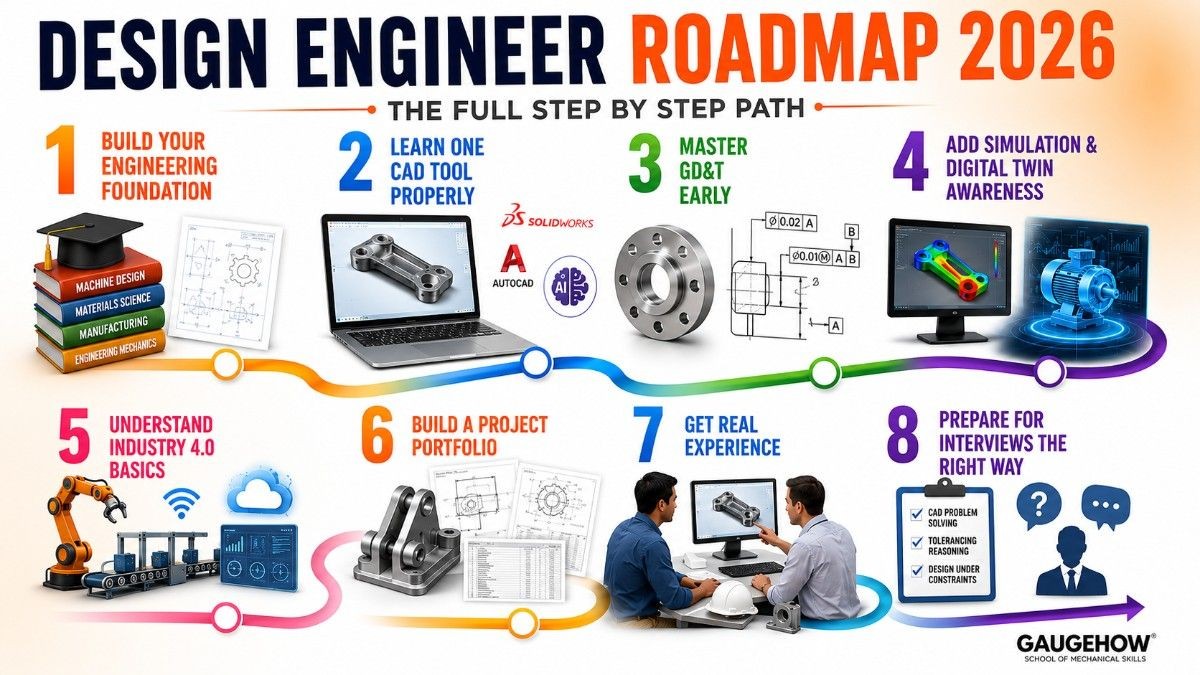
Step 1: Build Your Engineering Foundation
A bachelor's degree in mechanical, automotive, production, or industrial engineering is still the most common starting point.
Focus on subjects that show up daily on the job: machine design, materials science, manufacturing processes, and engineering mechanics. This is the theory layer. The next steps are what actually get you hired.
Step 2: Learn One CAD Tool Properly
Pick one CAD tool and go deep, rather than learning five tools at a surface level.
SolidWorks is the most requested tool for product and mechanical design roles. Our SolidWorks 2024 course covers part modeling, assemblies, and drawing generation.
AutoCAD is still the standard for 2D layouts and fabrication drawings across many industries. Start with the AutoCAD course.
Employers today also expect basic comfort with AI assisted CAD features such as generative design suggestions and automated drawing checks. You do not need to be an expert in this yet, but you should know what it does and why it is becoming part of the standard workflow.
Step 3: Master GD&T Early
Geometric Dimensioning and Tolerancing is how a design engineer communicates tolerances clearly enough for a machinist or quality inspector to build and check the part correctly.
Most fresh graduates skip this, which makes it one of the fastest ways to stand out in an interview. Our GD&T and Engineering Graphics course is built to close exactly this gap.
Step 4: Add Simulation and Digital Twin Awareness
You do not need to become a full time analyst, but a design engineer who can run a basic stress check, or who understands how digital twins are used to test a design before it is built, gets trusted with bigger projects sooner.
Two useful starting points are FEA with ANSYS for simulation basics and our Digital Twins course for understanding how design data connects to real world performance data, a skill that is becoming standard in 2026 workflows.
Step 5: Understand Industry 4.0 Basics
Cloud CAD, connected manufacturing, and IoT enabled production lines are now part of how design decisions get made, not a separate department's problem.
A short foundation in Industry 4.0 helps you understand how your design choices connect to the smart factory floor your part will eventually be built on.
Step 6: Build a Project Portfolio
Design engineering is visual and provable. Two or three well documented projects, such as a redesigned bracket with a tolerance stack up, or an assembly with a clear bill of materials, carry more weight than a resume full of bullet points.
Show the problem, your CAD process, the final drawing, and what you would change next time.
Step 7: Get Real Experience
An internship is the fastest path, but self driven projects and freelance CAD work are a fair substitute if a formal internship is not available.
What matters to employers is proof that you have taken a design from a rough idea to a manufacturable drawing under real constraints like cost and material limits.
Step 8: Prepare for Interviews the Right Way
Design engineer interviews usually test three things: how you think through a CAD modeling problem, how you reason about tolerances, and how you solve a design problem under constraints such as weight or cost targets.
Practice with real questions on the Interview Q&A Hub and test your fundamentals with our Practice and MCQ Tests before your interview.
Design Engineer Roadmap: Career Growth Stage by Stage
Stage | Experience | What Changes |
|---|---|---|
Junior Design Engineer | 0 to 2 years | Learning CAD, drawings, and basic DFM under supervision |
Design Engineer | 2 to 5 years | Owns full assemblies, starts mentoring juniors |
Senior Design Engineer | 5 to 8 years | Leads design reviews, works across teams, makes design tradeoffs |
Lead or Principal Design Engineer | 8 plus years | Sets design standards, technical authority across projects |
Design Engineering Manager | 8 plus years, people track | Leads a team, manages resourcing and career growth of engineers |
Around the 5 to 8 year mark, most design engineers choose one of two directions. The individual contributor track means going deeper technically and becoming the expert other engineers turn to.
The management track means stepping into people leadership and planning. Neither path is better than the other. It depends on whether you want to keep designing hands on or start leading a team.
Design Engineer Roadmap: Salary Growth in India
Numbers vary across salary sources, but the overall pattern is consistent:
Career Stage | Approximate Annual Salary (India) |
|---|---|
Fresher, 0 to 2 years | 3 to 6 LPA |
Mid level, 2 to 5 years | 6 to 12 LPA |
Senior, 5 to 8 years | 12 to 20 LPA |
Lead or Principal, 8 plus years | 20 LPA and above |
Engineers who combine CAD, GD&T, and simulation skills, especially in automotive, EV, and aerospace sectors, tend to land at the higher end of each band. City, company size, and specialization all move these numbers as much as raw experience does.
Design Engineer Roadmap: What 2026 Actually Changes
A few shifts are worth building into your plan now rather than later.
AI assisted design is becoming a normal part of CAD workflows, generating design options based on constraints like weight, cost, or material, so engineers can review and refine them faster.
Cloud based CAD is replacing older file based version control, making real time collaboration across teams and locations the norm.
Digital twins are moving from a niche concept into a standard tool for testing and monitoring designs before and after they go into production.
None of these replace the core skills in this roadmap. They sit on top of them. A design engineer who is solid in CAD and GD&T, and also comfortable with these newer tools, will have a clear edge over someone who only has the fundamentals.
FAQ: Design Engineer Roadmap 2026
Q: What is the fastest way to start a design engineer career in 2026?
A: Learn one CAD tool deeply, add GD&T, and build a small portfolio of real projects. This combination gets fresh candidates shortlisted faster than a broad but shallow skill list.
Q: Do I need to know AI tools to become a design engineer now?
A: Not to get started, but employers increasingly expect basic familiarity with AI assisted CAD features. It is worth learning once you are comfortable with core CAD and GD&T.
Q: How long does the full roadmap from fresher to senior design engineer take?
A: Roughly 5 to 8 years of hands on experience, though the timeline depends on how quickly you take ownership of full assemblies rather than just individual parts.
Q: Is a digital twins course actually useful for a design engineer, or is it more for automation roles?
A: It is increasingly useful for design engineers too, since digital twins are now used to test how a design performs before it is manufactured, which directly affects design decisions.
Q: Should I specialize early, or stay general as a design engineer?
A: Stay general for the first 2 to 3 years to build strong fundamentals, then specialize in a sector like automotive, EV, or aerospace once you know what you enjoy and where demand is strongest.
Conclusion
A design engineer roadmap in 2026 still starts with the same fundamentals it always has: strong CAD skills, real GD&T knowledge, and a portfolio that proves you can finish a design, not just start one.
What has changed is the layer on top: AI assisted tools, cloud collaboration, and digital twins are now part of the job, not optional extras. Build the fundamentals first, then add the newer skills on top.
Plan Your Next Step With GaugeHow
Explore the full Design Engineer career track on GaugeHow for a structured path through CAD, GD&T, simulation, and the newer skills shaping design engineering in 2026.
CAD-CAM-CAE Work Platform
Find or Post CAD, CAM and CAE freelance projects, full-time jobs and Internships.
GaugeHow is the platform built for core engineering work. Whether you need a freelancer for a CAD project, a full-time hire, or an engineering intern,post it here and get matched with the right person.