Mechanical Design Engineer Roadmap: Step by Step Career Guide

If you have a mechanical engineering degree and you are wondering what to actually learn next, you are not alone. Colleges teach the theory. They rarely teach the exact tools, drawing standards, and project types that get a mechanical design engineer hired.
This roadmap from GaugeHow fixes that gap. It covers the CAD tools, GD&T skills, industry domains, and career stages that make up a real mechanical design engineer roadmap, from your first internship to a senior design role.
Who Is a Mechanical Design Engineer?
A mechanical design engineer designs physical parts and assemblies that will actually be manufactured. That means building 3D CAD models, adding correct tolerances, checking whether the part can be produced at the right cost, and working with manufacturing and quality teams so the final part matches the drawing exactly.
Mechanical design engineers work across automotive, aerospace, consumer products, and industrial equipment, and the tools and expectations shift a little depending on which sector you enter.
Mechanical Design Engineer Roadmap
Step 1, Build the Right Foundation
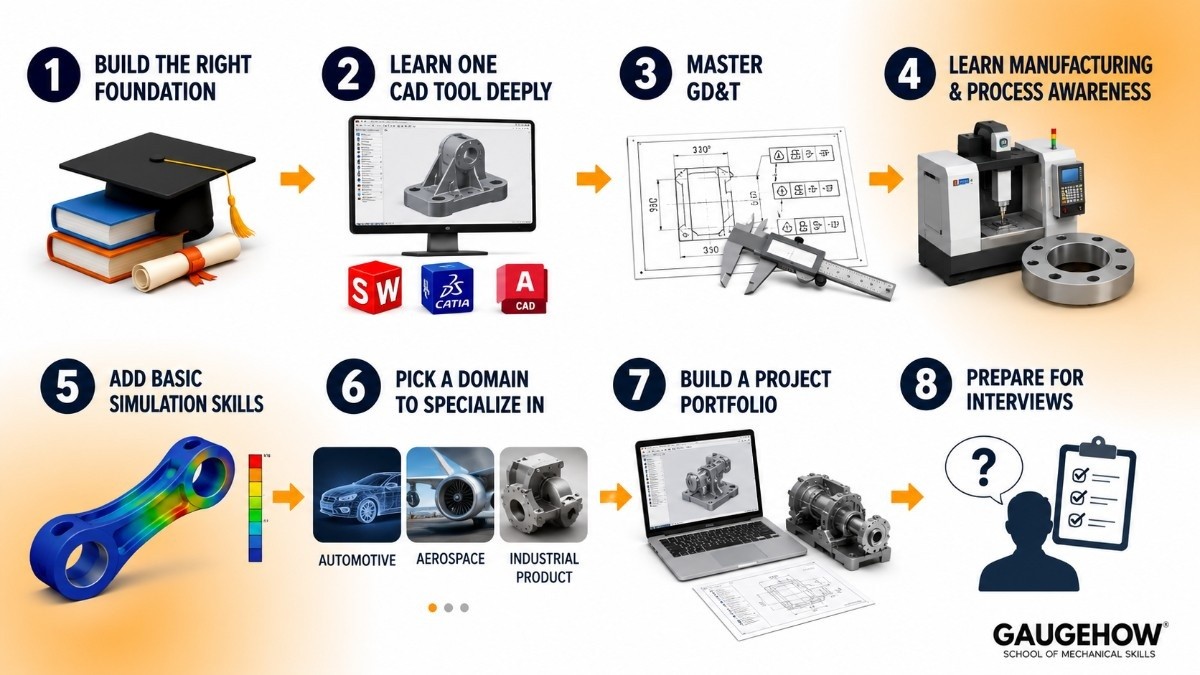
A bachelor's degree in mechanical engineering is still the standard entry point. During your degree, pay close attention to machine design, materials science, manufacturing processes, and engineering mechanics.
These subjects show up constantly once you are on the job. Everything after this step is about turning that theory into skills employers can actually test in an interview.
Step 2, Learn One CAD Tool Deeply
This is the single most important step in the entire roadmap. Employers filter mechanical design engineer resumes on CAD proficiency before anything else, so pick one tool and go deep instead of learning several tools at a shallow level.
SolidWorks is the most commonly requested tool for product and mechanical design roles. Our SolidWorks 2024 course covers part modeling, assemblies, and full drawing generation.
CATIA is heavily used in automotive and aerospace design, especially for surfacing and large assemblies. Start with our CATIA V5 course.
AutoCAD remains the standard for 2D layouts and fabrication drawings in many manufacturing setups. Our AutoCAD course covers this from the basics.
If you already know which sector you want to enter, let that guide your choice. Automotive and aerospace recruiters lean toward CATIA. Product and general mechanical design roles lean toward SolidWorks.
Step 3, Master GD&T Before You Apply
Geometric Dimensioning and Tolerancing is how a mechanical design engineer communicates tolerances that a machinist or quality inspector can actually build and check against.
Most fresh graduates skip this step, which makes it one of the fastest ways to stand out from other candidates in an interview. Our GD&T and Engineering Graphics course is built specifically to close this gap before you start applying.
Step 4, Learn Manufacturing and Process Awareness
A design that looks perfect in CAD but cannot be manufactured cheaply is not a finished design. Mechanical design engineers who understand manufacturing constraints, such as how a part will be machined, cast, or formed, produce designs that need fewer revisions later. Our CNC Programming course is a practical way to understand how your CAD model turns into an actual machined part, which makes your designs more manufacturing friendly from the start.
Step 5, Add Basic Simulation Skills
You do not need to become a full time analyst, but a mechanical design engineer who can run a basic stress check before sending a part to the simulation team gets trusted with bigger, more independent projects sooner. Our FEA with ANSYS course gives you enough simulation literacy to speak the same language as your analysis team and catch obvious design issues earlier.
Step 6, Pick a Domain to Specialize In
Mechanical design engineering is broad, and specializing makes you far more hireable than staying general once you have 1 to 2 years of experience. A few common paths:
Automotive design, covering body in white, sheet metal, and powertrain components. Recruiters in this space value CATIA and sheet metal knowledge highly. Browse GaugeHow's Automotive industry page for related learning paths.
Aerospace design, which demands stricter tolerances, more documentation discipline, and often GD&T mastery from day one. See the Aerospace industry page for a sense of what this sector expects.
Industrial and product design, covering machinery, jigs, fixtures, and consumer products, where SolidWorks is the most common tool.
You do not need to choose immediately, but knowing these paths exist helps you aim your early projects and courses at a specific hiring pool rather than a generic one.
Step 7, Build a Project Portfolio
Mechanical design engineering is a visual, provable skill. Two or three well documented projects, such as a redesigned bracket with a full tolerance stack up, a sheet metal enclosure, or a small gear assembly with a complete bill of materials, carry more weight in an interview than a resume full of bullet points.
For each project, show the original problem, your CAD process, the final drawing, and what you would change if you did it again.
Step 8, Prepare for Interviews the Right Way
Mechanical design engineer interviews usually test three things.
First, how you think through a CAD modeling problem out loud.
Second, how you reason about tolerances and why you chose a specific fit.
Third, how you solve a design problem under real constraints, such as reducing weight without losing strength. Practice with real interview questions on the Interview Q&A Hub before you walk into your first interview.
Mechanical Design Engineer Roadmap: Career Growth by Stage
Stage | Experience | What Changes |
|---|---|---|
Junior Mechanical Design Engineer | 0 to 2 years | Learning CAD, drawings, and basic DFM under supervision |
Mechanical Design Engineer | 2 to 5 years | Owns full assemblies, starts specializing in a domain |
Senior Design Engineer | 5 to 8 years | Leads design reviews, coordinates across teams and suppliers |
Lead or Principal Design Engineer | 8 plus years | Sets design standards, technical authority across projects |
Design Engineering Manager | 8 plus years, people track | Leads a team, manages resourcing and career growth of engineers |
Around the 5 to 8 year mark, most mechanical design engineers pick one of two directions. The individual contributor path means going deeper technically and becoming the specialist others rely on.
The management path means moving into team leadership and planning. Both are valid outcomes of the same roadmap.
Mechanical Design Engineer Roadmap: Salary Expectations in India
Salary figures vary across sources, but the general pattern across recent salary data is consistent:
Career Stage | Approximate Annual Salary (India) |
|---|---|
Fresher, 0 to 2 years | 3 to 6 LPA |
Mid level, 2 to 5 years | 6 to 12 LPA |
Senior, 5 to 8 years | 12 to 20 LPA |
Lead or Principal, 8 plus years | 20 LPA and above |
Engineers who combine strong CAD skills with GD&T and basic simulation knowledge, especially in automotive and aerospace design, tend to land at the higher end of each band.
Domain specialization, city, and company size all move these numbers as much as raw years of experience.
FAQ: Mechanical Design Engineer Roadmap
Q: Which CAD tool should I learn first for a mechanical design engineer role?
A: SolidWorks is the safest general choice. If you already know you want automotive or aerospace, CATIA is worth prioritizing instead.
Q: Is GD&T really necessary, or can I learn it after getting hired?
A: You can pick up parts of it on the job, but showing GD&T fluency in an interview is one of the clearest ways freshers stand out, since most candidates skip it entirely.
Q: Do I need simulation skills to be a mechanical design engineer?
A: Not as a full time skill, but basic FEA literacy helps you catch design issues earlier and makes you more independent, which employers notice quickly.
Q: How is a mechanical design engineer different from a general mechanical engineer?
A: Mechanical engineering is the broader discipline. Mechanical design engineering is a specialization within it, focused specifically on CAD modeling, tolerancing, and manufacturable drawings rather than the full range of mechanical engineering work.
Q: Should I specialize in automotive, aerospace, or general product design?
A: Stay general for your first 1 to 2 years to build strong fundamentals, then specialize once you understand which sector's day to day work and pace suits you best.
Conclusion
A mechanical design engineer roadmap comes down to a clear sequence: strong fundamentals, deep CAD skill in one tool, real GD&T knowledge, manufacturing awareness, and a portfolio that proves you can finish a design, not just start one.
Specialize once you know your direction, and the path from fresher to senior mechanical design engineer becomes far more predictable.
Start Building Your Roadmap With GaugeHow
Explore the full Design Engineer career track on GaugeHow for a structured path through CAD, GD&T, manufacturing, and simulation courses built for exactly this role.
CAD-CAM-CAE Work Platform
Find or Post CAD, CAM and CAE freelance projects, full-time jobs and Internships.
GaugeHow is the platform built for core engineering work. Whether you need a freelancer for a CAD project, a full-time hire, or an engineering intern,post it here and get matched with the right person.